
Engineering Overview
In B2B solar procurement and utility-scale development, the decision between deploying ground mounted solar racking systems and roof mounted solar mounting systems is not a matter of subjective preference; it is a rigid engineering and financial mandate dictated by the site’s physical constraints and the developer’s target Levelized Cost of Energy (LCOE). From a pure performance and scalability standpoint, ground mounts are the definitive standard for massive power generation, offering unconstrained layout flexibility, optimal tilt-angle calibration, and the ability to integrate high-yield tracking technologies. Conversely, roof mounts serve a highly specific, space-limited commercial function, capitalizing on existing structural footprints to completely bypass exorbitant land acquisition costs and complex environmental permitting.
To navigate this fundamental architectural divergence, developers must rely on a structured decision-making framework. This solar mounting comparison guide serves as the definitive engineering baseline, evaluating both systems across their structural integrity, geotechnical risk, installation velocity, and 25-year lifecycle ROI.
Quick Engineering Recommendation
| If You Need | Recommended System |
|---|---|
| Utility-scale solar farm (10MW+) | Ground Mount |
| Limited land availability / Urban setting | Roof Mount |
| Complex terrain or uneven topography | Ground Mount |
| Fast installation without civil earthworks | Roof Mount |

Video: a quick visual comparison of roof-mounted vs ground-mounted solar systems.
Ground Mount vs Roof Mount – Technical Comparison
| Evaluation Factor | Ground Mount | Roof Mount |
|---|---|---|
| Installation Cost | Higher (requires civil prep & heavy foundations) | Lower (utilizes existing building structure) |
| Structural Strength | Extreme (anchored directly into the earth) | Limited by host building’s dead load capacity |
| Wind Resistance | Highly customizable via steel up-gauging | Vulnerable to parapet uplift and aerodynamic edge effects |
| Maintenance Needs | Moderate (vegetation management, easy module access) | High (roof membrane protection, difficult access) |
| Lifespan | 25–30+ years (highly durable galvanized steel) | 20–25 years (dependent on underlying roof lifespan) |
| Energy Yield Impact | Optimal (ideal azimuth/tilt, bifacial compatibility) | Sub-optimal (constrained by roof slope and orientation) |
| Installation Speed | Fast at scale (mechanized pile driving) | Slower (crane logistics, safety fall-protection required) |
| Best Application | Utility-scale, large C&I open fields, remote microgrids | Urban commercial warehouses, factories, residential |
The matrix above delineates the stark contrasts in mechanical application. While roof mounts provide a faster, less invasive path to interconnection by eliminating trenching and soil testing, they strictly cap the maximum energy yield based on the geometry of the host building. Ground mounts demand a significantly more rigorous initial civil engineering phase—requiring extensive geotechnical reporting and heavy machinery mobilization—but ultimately deliver a vastly superior operational asset capable of maximizing every available photon without the arbitrary constraints of structural building limits.
What Is a Ground Mounted Solar System?
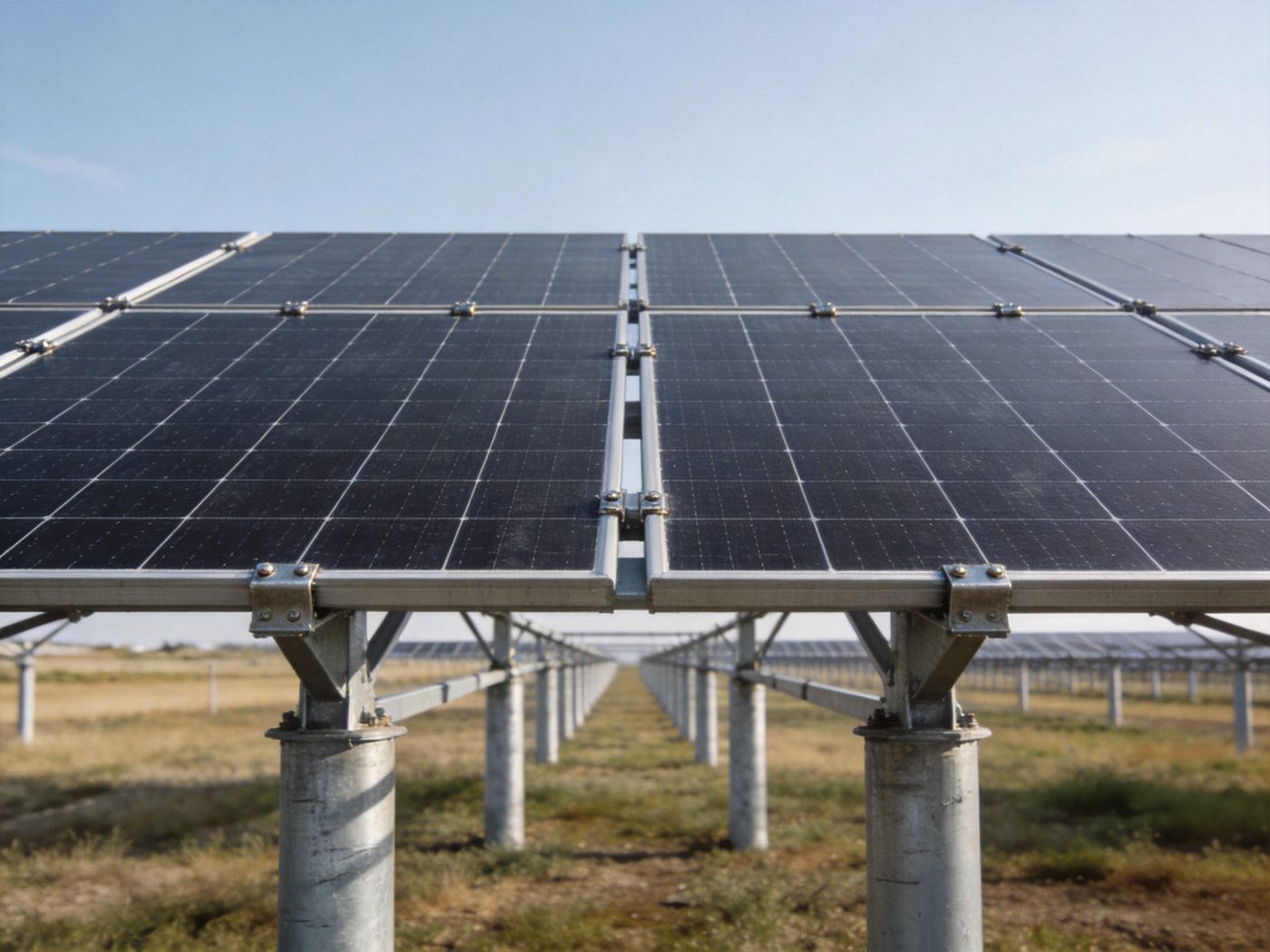
A ground mounted solar system is an independent, freestanding structural asset engineered to anchor photovoltaic modules directly to the earth. Unlike secondary roof structures, ground mounts are primary civil constructions designed to endure decades of dynamic environmental loading while maintaining absolute geometric precision.
Structural Characteristics
The core architecture of a ground mount relies on robust load-path engineering. Wind uplift and heavy snow loads transfer from the aluminum module frames into horizontal steel purlins, down through heavy-duty rafter brackets, into vertical column posts, and finally into the subterranean soil. The reliability of this load transfer is entirely dependent on the anchoring mechanism. In standard cohesive soils, engineers deploy a pile driven foundation, utilizing heavy machinery to rapidly sink galvanized C-channels or H-beams deep into the earth, relying on skin friction to resist uplift. When encountering dense cobble or subterranean bedrock, the architecture shifts to a ground screw foundation, which physically drills into hostile terrain to establish a secure mechanical lock without the need for extensive concrete excavation.
Typical Applications
Ground mounts are the undisputed backbone of utility-scale solar projects, where vast tracts of land are optimized for multi-megawatt generation arrays, frequently incorporating single-axis tracking hardware to maximize daily yield. Furthermore, they are extensively utilized in industrial solar installations where manufacturing facilities possess adjacent unused acreage, allowing the enterprise to offset massive energy consumption without threatening the structural integrity of their operational factories.
Advantages
The primary engineering advantage of a ground mount is its absolute optimization. The array can be oriented to true South (or true North in the Southern Hemisphere) at the mathematically perfect tilt angle for the site’s specific latitude. Additionally, the elevation off the ground provides immense passive convective cooling, lowering module operating temperatures and boosting electrical efficiency. The clearance also allows for high-yield bifacial modules to capture albedo (reflected light) from the earth. Maintenance is significantly safer and faster, as crews can walk the arrays and replace components without utilizing fall-protection harnesses or cranes.
Limitations
The drawbacks of ground mounts are inherently tied to real estate and civil risk. Acquiring, permitting, and preparing acres of land is an immensely expensive and bureaucratically slow process. Site grading, environmental impact studies, and security fencing add massive soft costs. Furthermore, the developer absorbs total geotechnical risk; discovering unmapped subterranean rock mid-project can obliterate the foundation budget and cripple the construction timeline.
[image:4]
What Is a Roof Mounted Solar System?
A roof mounted solar system is a secondary structural attachment that retrofits an existing building canopy into a power generation asset. This engineering approach treats the building’s internal trusses and load-bearing walls as the foundational baseline, attaching lightweight, specialized racking components to the exterior membrane.
Structural Characteristics
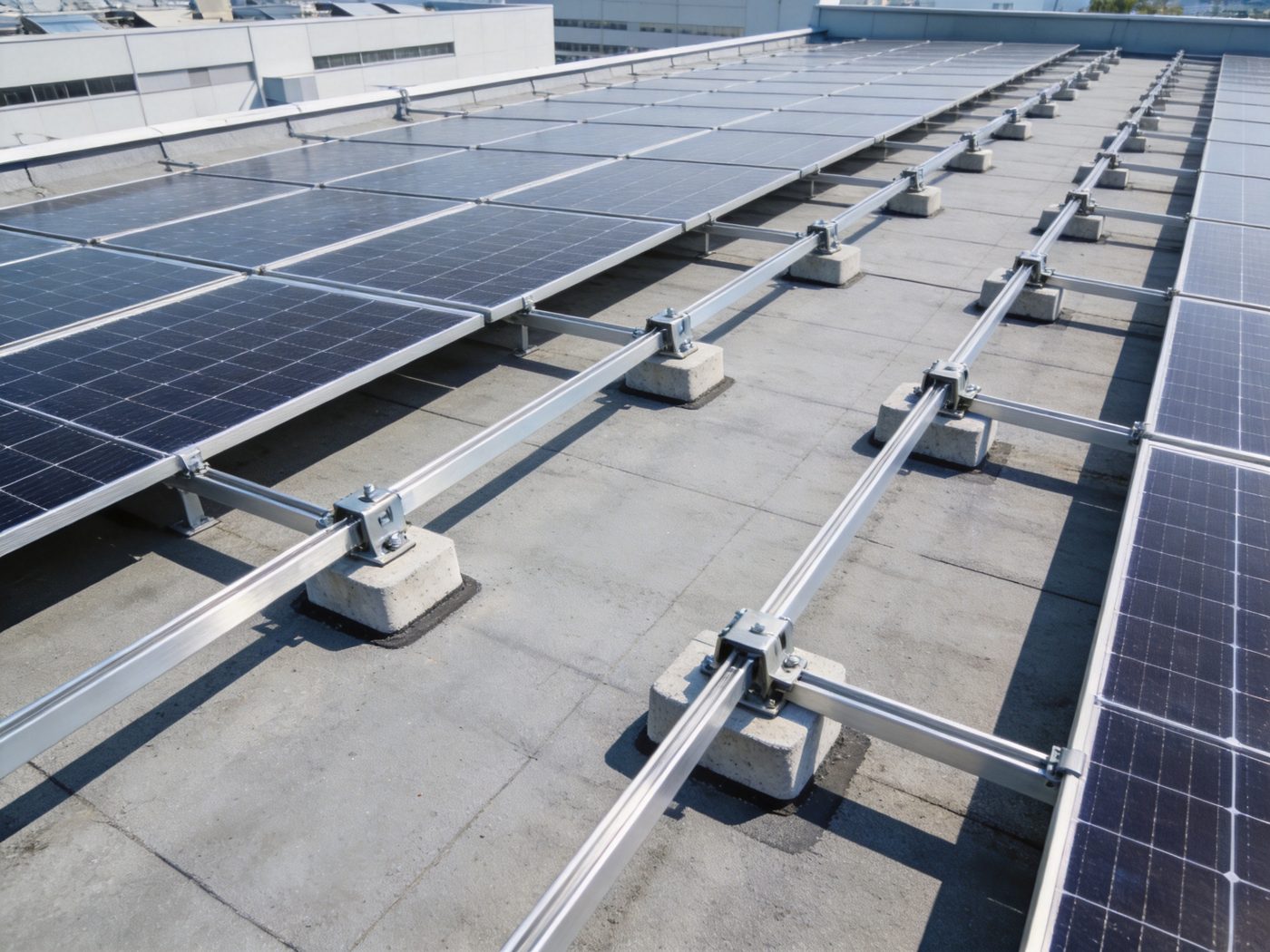
Roof mounts must solve the complex problem of securing modules against hurricane-force uplift without destroying the building’s primary waterproofing. The mechanical solution depends entirely on the roof substrate. A tile roof solar mounting system utilizes specialized stainless steel hooks that snake underneath the tiles to bolt directly into the underlying wooden rafters. A metal roof solar mounting system employs non-penetrating seam clamps that pinch the standing seams of a commercial metal roof, establishing a rigid connection with zero waterproofing risk. Conversely, a commercial flat roof solar mounting system often relies on an aerodynamic, ballasted design; heavy concrete blocks hold an interconnected web of lightweight aluminum deflectors to the roof surface, utilizing wind-tunnel-tested aerodynamics to prevent the array from sliding or lifting, thereby minimizing structural penetrations entirely.
Typical Applications
The spatial efficiency of roof systems makes them the mandatory choice for urban environments. They dominate commercial solar mounting projects, such as sprawling Amazon fulfillment centers or big-box retail stores, where massive, unobstructed flat roofs offer ideal deployment zones. They are also the exclusive framework for residential solar installations, where land is universally restricted, and aesthetic conformity to the pitched roofline is a primary homeowner requirement.
Advantages
The paramount advantage is the total elimination of land acquisition and civil foundation costs. Because the site is already disturbed and permitted for construction, environmental impact studies are bypassed, drastically accelerating the project timeline. Roof mounts position the generation asset immediately adjacent to the electrical consumption point, minimizing expensive trenching and long DC-cable home runs. The lightweight aluminum materials are fast to assemble, and non-penetrating ballasted systems preserve the integrity of expensive commercial roof warranties.
Limitations
Roof mounts are severely constrained by the host building. The existing pitch and azimuth rarely align with optimal solar metrics, guaranteeing a lower specific yield per panel compared to a ground mount. More critically, the array is strictly limited by the roof’s “dead load” capacity; many older commercial roofs cannot safely support the added weight of concrete ballasts or modules. Furthermore, if the roof membrane requires replacement in 10 years, the entire solar array must be expensively decommissioned, removed, and reinstalled.
[image:4]
Cost Engineering Analysis
Financial modeling for solar racking requires a comprehensive breakdown of upfront Capital Expenditure (CAPEX) versus long-term Operational Expenditure (OPEX). While roof mounts generally present a lower barrier to entry, ground mounts yield superior economies of scale over multi-megawatt deployments.
Initial Material Cost
The raw bill of materials diverges sharply between the two systems. Ground mounts consume massive tonnages of relatively inexpensive galvanized carbon steel for their heavy superstructures. Roof mounts consume far less material by volume, but rely on highly refined, expensive 6000-series extruded aluminum rails and specialized stainless steel fastening hooks. To accurately model how these varying metal indexes affect the baseline hardware price, developers must execute a detailed solar mounting material cost breakdown.
Foundation Cost Impact
Foundation execution is the largest cost differentiator. Roof mounts possess a foundation cost of zero—the building already exists. Ground mounts, however, must absorb the massive expense of geotechnical drilling and pile driving. If a ground mount site features unstable soils or landfill caps that prohibit driving steel, engineers must pivot to a heavy, cast-in-place concrete foundation, which dramatically inflates the civil budget and slows construction to the pace of curing cement.
Labor & Equipment Cost
Ground mount labor scales brilliantly. A mechanized crew utilizing GPS-guided pile drivers and telehandlers can install megawatts per week in a flat field, driving the per-watt labor cost to absolute minimums. Roof mount labor is inherently bottlenecked. Materials must be craned onto the roof in limited batches, and workers must navigate OSHA fall-protection safety protocols, roof slope hazards, and complex wire-management pathways, resulting in a significantly higher hourly labor cost per installed watt.
Transportation & Logistics
Ground mount materials are incredibly heavy and bulky, resulting in high oceanic and inland freight costs. Shipping thousands of steel H-beams requires massive logistics planning. Roof mount materials are lightweight and highly modular, allowing for dense container packing and cheaper, faster localized transit to urban commercial centers.
25-Year Lifecycle Cost Projection
Over a 25-year horizon, the financial dynamics invert. The ground mount’s higher initial CAPEX is aggressively amortized by its superior energy yield and minimal operational friction. Roof mounts carry the latent, massive financial liability of roof membrane replacement. If an asset owner must remove a 2 MW rooftop array in Year 15 to fix a leaking roof, the labor cost of removal and reinstallation will completely destroy the project’s profitability. To accurately map this long-term financial exposure, stakeholders must perform a rigorous solar mounting lifecycle cost analysis.
Run the numbers: on a ground mount, wind load usually governs the structure. Estimate the velocity pressure on your array with our free solar wind load calculator before you size the steel.
Structural Performance Comparison
Both systems must survive brutal environmental loading, but they interact with aerodynamic and kinetic forces in entirely different ways. Engineering failure in either domain results in catastrophic asset loss.
Wind Load Resistance
Ground mounts face raw, unobstructed boundary-layer winds. They are engineered to resist immense lateral pushing forces and aerodynamic flutter, mitigated by deepening pile embedment and thickening steel profiles in accordance with localized wind load standards. Roof mounts, however, face highly complex vortex shedding and extreme localized uplift at the roof’s edges and parapets. A ballasted roof mount must perfectly balance its aerodynamic deflectors to ensure high-velocity winds push the array *down* into the roof, rather than lifting it off the building.
Snow Load Capacity
In northern climates, ground mounts are highly advantageous. Their steep, adjustable tilt angles encourage snow shedding, and the clearance beneath the modules allows heavy snow to pile up without burying the array. Roof mounts, particularly flat ballasted systems tilted at a shallow 10 degrees, cannot naturally shed snow. The static dead weight of the accumulated snow sits directly on the modules, severely threatening the structural capacity of the host building’s underlying roof trusses.
Seismic Stability
Ground mounts are extremely resilient to seismic activity; the steel piles possess inherent ductility, allowing the structure to flex and absorb lateral ground shear during an earthquake without shattering the glass modules. Roof mounts are subject to the amplified swaying motion of the host building. In high-seismic zones, ballasted roof arrays must be mechanically tethered (hybrid-attached) to the roof deck to prevent the entire array from violently sliding across the membrane during a seismic event.
Corrosion Durability
Ground mounts battle subterranean chemistry. The steel piles are constantly exposed to soil acidity, moisture, and stray electrical currents, requiring thick Hot-Dip Galvanization or specialized epoxy coatings to survive 30 years in the dirt. Roof mounts avoid soil entirely, but their aluminum and stainless steel components must resist atmospheric corrosion, particularly the severe salt-spray degradation found in coastal urban deployments.
Terrain Adaptability
Ground mounts can be engineered with articulating joints and variable pile lengths to seamlessly flow over undulating hills, valleys, and highly irregular topographies. Roof mounts are rigidly dictated by the architect’s original blueprint; they cannot easily adapt to multi-tiered roofs, heavy HVAC equipment shading, or irregular parapet geometries without undergoing highly expensive, custom engineering modifications.
Installation & Construction Complexity
The physical execution of the project dictates the construction schedule. Delays in mechanical deployment immediately postpone grid interconnection, pushing the project’s revenue generation backward and harming the ROI.
Site Preparation Requirements
Ground mounts demand heavy civil engineering. The land must be cleared of timber, graded to remove extreme slopes, and trenched for miles of DC cabling and grounding loops. Environmental runoff and stormwater management plans must be strictly enforced. Roof mounts require zero earthmoving, but demand rigorous structural engineering audits. A licensed structural engineer must physically inspect the roof trusses to certify they can handle the additional 4–6 lbs per square foot of dead load imposed by the racking and modules.
Required Machinery
A utility ground mount functions as a heavy civil construction site, dominated by diesel-powered, GPS-guided pile driving rigs, excavators, and all-terrain telehandlers. Roof mount sites require towering commercial cranes to lift pallets of modules and ballasts onto the roof deck, followed by lightweight, specialized roofing carts to distribute the weight evenly without punching through the insulation.
Installation Timeline
Once a ground mount site is graded and the piles are driven, the mechanical assembly is blisteringly fast. Specialized crews fall into a rapid, repetitive rhythm, easily completing megawatts per week. Roof mount timelines are constantly disrupted by logistical bottlenecks: waiting for crane availability, halting work due to high winds (which makes roof-work lethally dangerous), and the slow, meticulous process of ensuring no tools or screws puncture the delicate TPO or EPDM roof membrane.
Skill Level Required
Ground mounts rely heavily on heavy-machinery operators and general mechanical labor capable of reading laser levels and torquing heavy bolts. Roof mounts require a highly specialized crossover of mechanical assembly and commercial waterproofing expertise. If a roof mount installer improperly seals a penetration on a pitched roof, the resulting water leak will cause hundreds of thousands of dollars in interior building damage, generating massive liability for the EPC.
Long-Term Operational Impact
Procurement is a one-time event, but operations and maintenance (O&M) persist for decades. The architectural choice fundamentally alters how asset managers interact with the power plant over its 25-year lifecycle.
Maintenance Frequency
Ground mounts are highly accessible. Technicians can drive a truck directly to a failing inverter or module and replace it in minutes. The primary maintenance burden is vegetation management—mowing grass or grazing sheep to prevent weeds from shading the lower module edges. Roof mount access is notoriously difficult, often requiring security clearances, roof-hatch access, and safety spotters. To effectively manage this complexity, O&M teams must adhere to a strict solar mounting inspection checklist, ensuring that ballasts have not shifted and that roof drains are not clogged by accumulated solar debris.
Component Replacement Cycle
The heavy galvanized steel of a ground mount is designed to outlast the photovoltaic modules themselves; it rarely requires component replacement unless struck by heavy machinery or extreme weather. Roof mounts, however, often outlive their host roofs. If a 15-year-old commercial roof begins to fail, the entire solar array must be meticulously un-wired, un-bolted, lifted off the roof, stored, and then entirely re-installed after the new roof is laid. This replacement cycle is the single greatest financial threat to a roof-mounted PPA.
25-Year ROI Projection
When modeling the 25-year financial trajectory, ground mounts consistently generate a higher absolute ROI. Their ability to track the sun (if single-axis trackers are used), optimize the tilt angle, and run cooler translates to massive cumulative energy gains that easily amortize the higher initial civil costs. Roof mounts deliver a lower, but highly stable, ROI. Their financial strength lies in avoiding land costs and delivering “behind-the-meter” power directly to the host facility, cutting out transmission losses and yielding immediate corporate utility savings.
Decision Matrix by Project Type
To streamline B2B procurement, developers must align the project’s physical constraints with the correct structural architecture. This matrix maps common deployment scenarios to their optimal engineering solutions.
| Project Type | Recommended Option | Engineering Justification (Why) |
|---|---|---|
| Utility-scale | Ground Mount | Maximum scalability, allows for tracking hardware to optimize yield, unconstrained by building dimensions. |
| Commercial rooftop | Roof Mount | Monetizes unused overhead space, avoids immense urban land acquisition costs, provides behind-the-meter power. |
| Residential | Roof Mount | Preserves limited yard space, conforms to zoning and HOA aesthetics, utilizes existing steep-pitch angles. |
| High wind area | Ground Mount | Can be structurally anchored deep into the earth; avoids the extreme aerodynamic uplift effects found at roof edges. |
| Soft soil | Depends on foundation | Ground mount requires deep piles or concrete; if civil costs explode, adjacent heavy commercial roofs may be cheaper. |
| Heavy snow | Ground Mount | Steep adjustable tilt allows for rapid snow shedding; ground clearance prevents the array from being buried in drifts. |
Applying this matrix ensures that EPCs do not force an incompatible technology into a hostile environment. Attempting to build a massive ground mount in a dense urban zone or forcing a heavy ballasted array onto an aging, fragile warehouse roof will inevitably result in project failure or catastrophic budget overruns.
Engineering Decision Flowchart
For rapid procurement assessment, follow this sequential engineering logic:
Step 1: Land Availability. Do you have access to open, unshaded acreage? If YES, proceed to Ground Mount evaluation. If NO, default to Roof Mount.
Step 2: Geotechnical & Structural Feasibility. For Ground: Can the soil support driven piles without hitting immediate bedrock? For Roof: Can the building’s trusses support an additional 5 lbs/sq ft of dead load?
Step 3: Energy Goal vs. CAPEX. Do you require maximum energy generation (LCOE focus)? Select Ground Mount for optimal tilt and tracking. Do you require the lowest initial installation barrier (CAPEX focus)? Select Roof Mount to bypass heavy civil excavation.
Step 4: Long-Term Liability. Will the commercial roof need replacing in the next 10 years? If YES, do not install a roof mount until the building is re-roofed.
Frequently Asked Engineering Questions
Does a ground mount always produce more energy than a roof mount?
Yes, almost universally. Because a ground mount is not constrained by the arbitrary angle or orientation of a building, engineers can set the panels at the mathematically perfect tilt and true-south azimuth for that specific latitude. Furthermore, ground mounts benefit from passive convective cooling airflow beneath the panels, which prevents the heat-induced voltage degradation that frequently suppresses the output of hot, flush-mounted rooftop arrays.
Are roof mounts cheaper to install than ground mounts?
In terms of initial CAPEX, yes. Roof mounts entirely bypass the heavy civil engineering phase. There is no land to clear, no expensive geotechnical soil testing, no trenching for cables, and no heavy pile-driving machinery required. However, the cost per watt for installation labor can be higher due to the slow, meticulous crane logistics and safety protocols required when working at elevation.
How do wind loads differ between ground and roof structures?
Ground mounts face uniform boundary-layer winds that push and pull laterally across the face of the array, requiring heavy steel posts to resist overturning moments. Roof mounts face highly chaotic wind dynamics. As wind hits the face of a building and shoots upward over the parapet wall, it creates a massive localized vacuum (uplift) at the corners and edges of the roof. Ballasted roof mounts must utilize wind-tunnel-tested deflectors to counteract this specific aerodynamic suction.
What is the biggest hidden cost in roof mounting?
The absolute largest hidden liability is roof membrane replacement. If an EPC installs a 25-year solar array on a commercial TPO roof that only has 8 years of viable life remaining, the building owner will soon face a crisis. Removing the solar array, storing it, replacing the roof membrane, and re-installing the solar racking can cost hundreds of thousands of dollars, completely destroying the project’s long-term ROI.
When is it necessary to transition a project from a roof mount to a ground mount?
A transition is mandatory when a licensed structural engineer determines that the host building’s trusses cannot support the additional dead load of the ballasts and modules. It is also required if the roof is heavily cluttered with HVAC units, skylights, and vents, leaving insufficient contiguous square footage to generate the target megawatt capacity required by the facility.
How does tracking technology affect this decision?
Tracking technology fundamentally separates the two systems. Single-axis trackers, which follow the sun from east to west to boost energy yield by up to 25%, are exclusively deployed on ground mounts. The mechanical complexity, movement footprint, and dynamic structural forces of a tracking system cannot be safely or economically integrated onto a standard commercial roof deck.
Related Solar Mounting Resources
To further refine your structural engineering procurement and explore detailed system specifications, consult our interconnected technical reference library:
Related Mounting Types
Related Foundation Guides
Related Cost Analysis
Return to Comparison Hub