
Before choosing: normalize every bid
A low price can be legitimate value engineering, and a high price is not proof of durability. Put every bidder on the same design basis, then reject unsupported claims. The comparison below turns the most repeated installer concerns—loose clamps, finish failures, missing hardware and difficult replacement—into procurement evidence.
| Normalize | Evidence required with the bid | Commercial consequence if omitted |
|---|---|---|
| Loads and geometry | Governing code, wind/snow/seismic inputs, module and clamp zones, spans, deflection criteria and foundation reactions | Do not compare price until assumptions match |
| Bill of materials | Grade/alloy, thickness, section properties, fastener grade, coating standard/designation and repair method | Treat “galvanized” or “heavy duty” alone as incomplete |
| Connection control | Approved hardware, torque values and tolerances, installation sequence, torque-audit sample and substitution rules | Price field rework and QA time explicitly |
| Traceability and inspection | Mill certificates, coating records, lot traceability, incoming inspection and nonconformance process | Add hold points or disqualify an unverifiable supply chain |
| Lifecycle obligations | Warranty entity, exclusions, spare-part availability, inspection plan and repair access | Model expected maintenance and downtime; do not assume zero O&M |
Use an expected lifecycle cost model: delivered and installed CAPEX + scheduled inspection + probability-weighted repair/replacement and downtime − recoverable residual value. Keep each probability and unit cost visible so the result can be challenged. Do not invent a universal “Year 15” failure or a fixed percentage premium.
Engineering overview
“Cheap” and “durable” are commercial labels, not engineering properties. A lower-price system may be fully compliant and efficient; a premium system may still contain mismatched loads, weak connection control or an unsuitable corrosion specification. The evidence—not the adjective—decides.
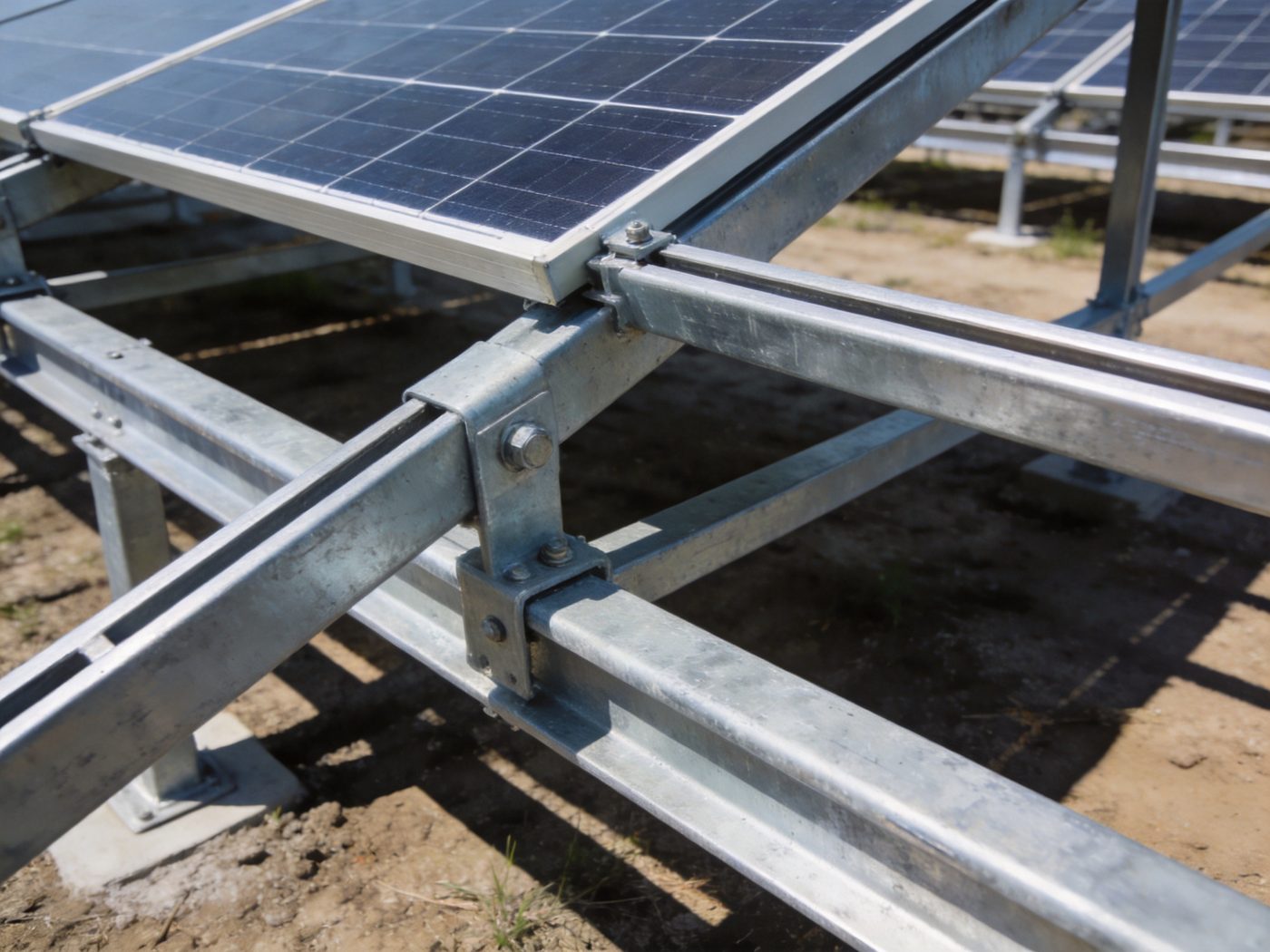
Field and post-storm reports repeatedly point to critical connections: unsuitable or substandard components, incorrect torque, vibration-induced loosening, joint relaxation, inadequate strength for actual loading and clamp failures. The procurement response is a common design basis plus auditable installation and QA controls.
Evidence-based comparison
| Claim in a bid | Evidence that makes it credible | Decision |
|---|---|---|
| “Code compliant” | Project calculations, governing edition, loads, member/connection checks and sealed/stamped status where required | Accept only for the stated site and layout |
| “Long-life coating” | Coating standard/designation, measured requirement, fabrication sequence, exposure basis and repair method | Model time to maintenance; do not accept a generic year claim |
| “Faster installation” | Part count, crew study, tolerances, tools, torque process and punch-list history | Price the verified labor delta |
| “Maintenance free” | Inspection plan, exclusions and site-specific experience | Treat zero O&M as an unsupported assumption unless proven |
| “Bankable warranty” | Named obligor, remedy, exclusions, transferability, claim process and spare-part support | Evaluate enforceability, not headline duration |
What a lower-cost system can mean
A lower total can result from structural efficiency, optimized sections, high-volume production, compact packing, short transport, simplified installation or a narrower commercial scope. It can also result from omitted documentation, inspection, hardware or corrosion protection. The quotation must identify which.
Do not infer: steel grade, section thickness, safety factor, coating route, redundancy, warranty strength or service life from price alone.
What demonstrates durability
- Project-specific load and serviceability checks, including every critical connection.
- Materials and coatings traceable to named standards and acceptance records.
- Installation instructions with torque, tolerances, substitution limits and audit sampling.
- Exposure-appropriate drainage, dissimilar-metal, cut-edge and damage-repair details.
- A practical inspection, spare-parts and warranty-remedy plan through the operating term.
Lifecycle cost without invented failure years
Calculate delivered hardware, foundations, freight, lifting, crew time, QA, scheduled inspection, probability-weighted repair/replacement, downtime and residual value. Show low/base/high assumptions and discount rate. A durability premium is justified only when it reduces a documented risk or cost.
For corrosion, use the specified coating and actual environment. For wind risk, use project loading and connection capacity. Do not substitute a universal “15-year budget life,” a brand tier or a price-per-kilogram rule for those inputs.
Structural performance: inspect the load path
Review module clamp zones, clamp-to-rail slip, rail splices, bracing, post and foundation reactions, tolerances and substitutions. DOE and FEMA observations show that a small connection detail can govern array survival even when the main members remain in place.
Require component-level capacity documentation and an installation verification plan for critical fastened joints. More steel does not automatically correct a weak clamp or a missed torque step.
Installation evidence to request
- Mock-up or first-article acceptance before full production.
- Approved tool and torque range, calibration records and torque-audit sampling.
- Lot control for fasteners and explicit rules for field substitution.
- Tolerance and rework procedure for misaligned holes or damaged coatings.
- Photo records and punch-list closure for critical connections.
Warranty and O&M reality check
Translate the warranty into actions: who inspects, what evidence preserves coverage, who pays access and labor, what constitutes a defect, and how long compatible parts remain available. Set inspection frequency from exposure, criticality and observed condition—not from the system’s price label.
Decision matrix by evidence gap
| Finding | Action |
|---|---|
| Same scope and verified performance; one bid is lower | Lower cost is legitimate value—confirm exclusions and select commercially |
| Loads, BOM or coating are not comparable | Return for clarification; do not rank price |
| Critical connection capacity or torque control missing | Stop technical approval |
| Durability claim lacks exposure and maintenance basis | Replace the claim with a scenario range |
| Warranty has unclear remedy or obligor | Price the risk or require revised terms |
Procurement sequence
- Freeze the common design and commercial scope.
- Compare deviations and evidence, not labels.
- Stop on missing safety, connection or material identity.
- Model lifecycle scenarios with visible assumptions.
- Approve the lowest total-risk compliant alternative.
Frequently Asked Engineering Questions
Does a lower-priced racking system automatically have a shorter life?
No. Price can reflect material quantity, design efficiency, automation, logistics, scope or commercial strategy. Compare identical design inputs, the bill of materials, coating specification, QA evidence, installation controls and lifecycle obligations.
Can coating type alone prove which bid is more durable?
No. The coating standard and designation, steel thickness, fabrication sequence, cut-edge and repair details, site exposure, drainage and inspection plan all affect performance.
Do code-compliant systems all have the same reserve capacity?
No, and a price label does not reveal reserve capacity. Review the project calculations, load combinations, member utilization, serviceability checks, connections and approved substitutions.
What is the fastest way to compare two mounting bids?
Issue one normalized data sheet and require each bidder to list deviations. Do not compare totals until loads, scope, material identity, coating, fasteners, QA, freight and installation responsibilities match.
How should lifecycle cost be estimated?
Use transparent project-specific ranges for installed CAPEX, inspection, probability-weighted repair or replacement, downtime and residual value. Sensitivity-test the assumptions instead of using a universal failure year.
Evidence and Related Solar Mounting Resources
Research evidence used for this revision
- U.S. Department of Energy — Severe Weather Resilience in Solar PV System Design: observed fastened-joint failure modes and procurement/installation controls.
- FEMA Mitigation Assessment Team report: documented module-frame and connection failures under hurricane loading.
- U.S. Department of Energy — PV corrosion guidance: exposure assessment, fastener risk and maintenance controls.
Refine your procurement strategy by cross-referencing your budget against detailed technical specifications using our engineering library:
Related Mounting Types
Related Material Guides
Related Cost Analysis
Return to Comparison Hub