
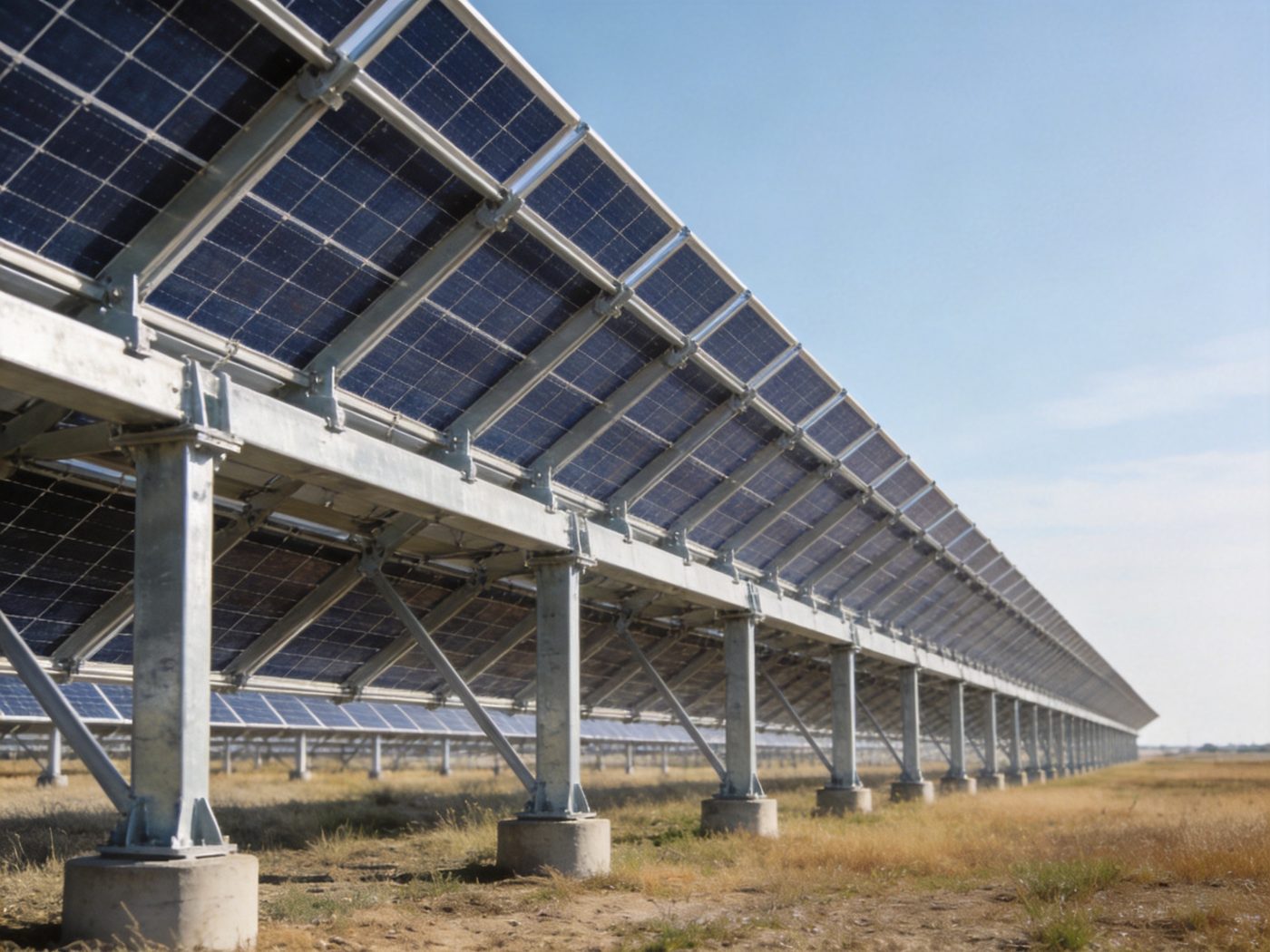
Scope: This is a terminology and project-input page for ground-mounted PV pre-feasibility. It is not a structural design, product approval, construction instruction, bankable energy model or financial recommendation.
Fixed tilt and single-axis tracking in plain language
| Term | What it means | What still needs project evidence |
|---|---|---|
| Fixed tilt | Modules remain at a selected tilt and azimuth after installation. There is no tracker drive train. | Layout, row spacing, foundations, loads, drainage, module compatibility, losses and maintenance plan |
| Single-axis tracker | Rows rotate around one axis according to a control strategy. Backtracking may change the ideal sun-facing angle to reduce row shading. | Axis geometry, rotation limits, GCR, backtracking, stow states, controls, power-loss behavior, commissioning and service scope |
Both descriptions cover product families, not one standard design. Foundation type, row length, allowable terrain, drive architecture and control behavior vary by supplier and project.
Why this page does not name a universal winner
A tracker can collect more energy per installed watt in a suitable model, but the difference is not a transferable percentage. Direct and diffuse irradiance, row geometry, backtracking, terrain, clipping, curtailment, stow, auxiliary energy and availability all affect the result.
Fixed tilt removes tracker drives and controls, but it is not maintenance-free or automatically safer. Both architectures need project-specific structural requirements, inspection, storm response and corrective work. A valid selection compares the same site, capacity, weather period, module, inverter and financial boundary.
For the full workflow, use Solar Tracker vs Fixed Tilt: a site-specific decision guide.
Inputs to gather before comparing layouts
| Input group | Minimum information |
|---|---|
| Site | Survey, buildable boundary, slope, drainage, exclusions, access and geotechnical basis |
| Electrical | DC and AC capacity, module and inverter, DC/AC ratio, clipping and point of interconnection |
| Weather and energy | Weather source and period, irradiance components, model/version, geometry and loss diagram |
| Layout | Module count, GCR, row pitch, row length, foundations, grading and cable quantities for each option |
| Tracker controls | Rotation and backtracking settings, operating/stow states, sensing, communications and loss-of-power behavior |
| Commercial and O&M | Dated scope and exclusions, civil work, commissioning, spares, preventive tasks, response times and modeled downtime |
Run both equal-capacity and equal-land comparisons when land productivity can change the decision. Keep inputs traceable so an apparent advantage can be tested rather than asserted.
Construction and commissioning differences to verify
Fixed-tilt and tracking layouts can differ in repetition, alignment tolerances, control wiring, communications, commissioning and spare-parts scope. The direction and size of those differences depend on the selected products, foundations and site.
- Ask both suppliers to return layouts from the same survey and geotechnical information.
- Normalize grading, drainage, foundations, roads, cabling, installation equipment and commissioning exclusions.
- For trackers, record position checks, control tests, communications tests and every protective operating state.
- For fixed tilt, retain structural, electrical, fastener, vegetation and storm-response inspection tasks.
- Do not copy generic pile depth, spacing, wind speed, stow angle or replacement cycle into project documents.
Choose the next resource by question
Which architecture fits this site?
Use the site-specific tracker vs fixed-tilt decision guide for energy, land, resilience and O&M.
How should lifecycle cost be modeled?
Use the tracker vs fixed-tilt cost framework for CAPEX, O&M, downtime and sensitivity inputs.
How does each product family work?
Read the fixed-tilt overview and single-axis tracker overview.
Evidence and modeling boundary
- NREL PVWatts — public screening model for fixed and tracking array configurations.
- pvlib single-axis tracking documentation — explains geometry, GCR and backtracking inputs.
- U.S. DOE severe-weather PV guidance — site hazard and protective operating-state context.
- NREL PV O&M best-practices guide — maintenance planning and service-history framework.
Boundary: These sources help define inputs and challenge assumptions. They do not approve a product or project and do not establish a universal yield, cost, load, lifespan or payback value.
Frequently asked questions
What is the basic difference between fixed tilt and a single-axis tracker?
Fixed tilt holds modules at a selected orientation. A single-axis tracker rotates rows around one axis according to its geometry and control strategy.
Does a single-axis tracker always produce enough extra energy to justify its cost?
No universal rule answers that question. Compare both options with the same site weather, capacity, layout basis and losses, then add complete capital, operating and downtime assumptions.
Is fixed tilt maintenance-free?
No. It avoids tracker drives and controls but still needs monitoring, vegetation management, electrical and structural inspection, storm response and corrective work.
Can this ground-mount comparison be applied to a rooftop?
Not automatically. Roof geometry, structure, waterproofing, fire access and product approvals create a different decision. Use a roof-specific system and applicable building review.