
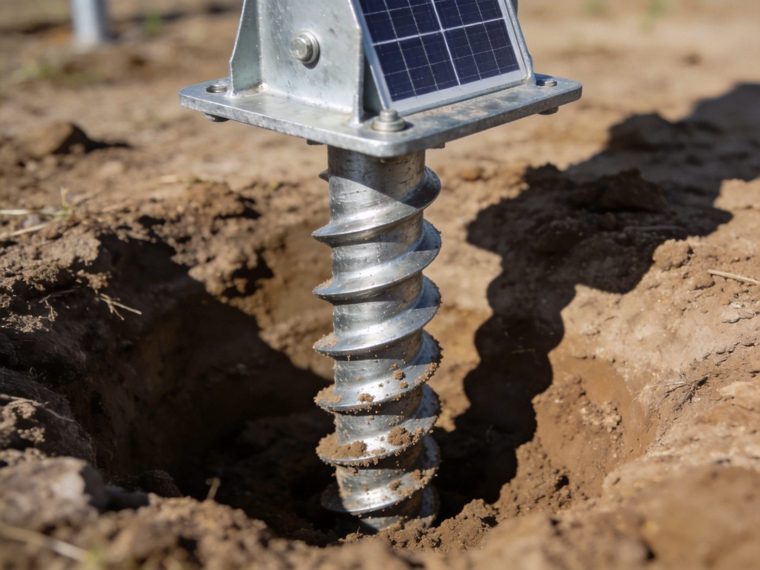
Ground screw foundations — also called helical piles, helical anchors, or screw piles — are rotary-installed steel foundation elements that develop structural capacity through the bearing resistance of one or more helical plates welded to a central steel shaft, without concrete, without excavation, and without the noise and vibration of impact pile driving. Ground screw foundations are among the most efficient solar foundation systems for rapid installation in diverse soil conditions — achieving installation rates of 150–400 screws per day per torque rig, with capacity verified in real time through the torque-to-capacity correlation during installation, and with full site reversibility at end of project life that no concrete or driven pile foundation can match. For a comprehensive overview of all available solar foundation types — including the selection criteria that determine when ground screws are structurally and commercially superior to pile driven, concrete, or ballasted alternatives — refer to our Solar Foundation Systems Guide.
The defining engineering characteristic of ground screw foundations is the torque correlation: installation torque measured at the drive head during screw advancement correlates directly to the soil bearing capacity at the helix depth — providing a continuous, real-time structural capacity verification record for every screw installed, which is impossible with driven piles (where capacity verification requires separate static load testing) and concrete foundations (where capacity verification requires laboratory concrete strength testing). This real-time capacity confirmation makes ground screws the most structurally transparent foundation type in solar mounting engineering — and the basis for their widespread adoption in quality-conscious utility-scale project delivery where foundation capacity documentation is a lender and owner requirement.
Technical Snapshot: Ground Screw Foundation Key Parameters for Solar Mounting
| Parameter | Typical Value / Range | Governing Condition | Engineering Note |
|---|---|---|---|
| Embedment Depth | 1.0–2.0 m standard; 2.0–3.5 m in soft cohesive soil or high-uplift high-wind environments; 0.6–1.0 m in dense gravel or weak rock to helix refusal | Torque correlation to required axial/uplift capacity; frost depth; lateral stiffness requirement | Unlike driven piles where embedment depth is the primary design variable, ground screw capacity is governed by the torque at final embedment depth — a screw achieving design torque at 1.2 m embedment is structurally equivalent to one at 1.8 m that achieves the same torque; depth is a means to torque, not an end in itself |
| Shaft Diameter | 76 mm OD (standard light-duty); 89 mm OD (standard); 101–114 mm OD (heavy-duty); 140–168 mm OD (high-capacity or weak soil) | Lateral load demand (lateral stiffness EI scales with shaft diameter⁴); uplift capacity; drivability in dense soil | Lateral stiffness — not axial capacity — typically governs shaft diameter selection for solar mounting screws; a larger-diameter shaft at shorter embedment frequently provides better lateral stiffness than a smaller-diameter shaft at greater depth, and costs less per screw |
| Helix Plate Diameter | 200–250 mm (single helix, standard soil); 250–300 mm (double helix, soft soil); 300–400 mm (large-diameter single helix, very soft soil or high-uplift) | Axial compression and uplift bearing capacity; soil bearing pressure at helix (q = T/Kt/Ahelix) | Double helix configurations (two plates at defined spacing) increase axial and uplift capacity by 70–90% over single helix at equivalent shaft diameter; lead helix advances ahead, disturbs soil minimally; trailing helix installs into undisturbed soil, developing full bearing capacity independently |
| Torque Correlation (Kt) | Kt = 8–12 ft⁻¹ (2.6–3.9 m⁻¹) for standard round shaft; Kt = 7–10 ft⁻¹ for square shaft; Kt varies by shaft size and soil type per ICC-ES AC358 / ASTM A1180 | Shaft diameter; shaft cross-section geometry; soil type | Capacity = Kt × Tinstallation; at Kt = 10 ft⁻¹ and Tinstallation = 3,500 ft·lb (4,746 N·m): Qallowable = 10 × 3,500 = 35,000 lbs = 156 kN (ASD); this real-time capacity calculation from recorded torque is the structural transparency advantage that ground screws provide over all other foundation types |
| Corrosion Protection | Hot-dip galvanizing (HDG) per ASTM A123: minimum 86 µm (3.4 mils) below grade; 610 g/m² zinc coating for structural steel sections; duplex (HDG + epoxy) for C4–C5 soil | Soil ISO corrosion category; groundwater presence; soil pH and chloride content; design service life (25 vs 40 years) | Below-grade screw corrosion is irreversible; the helix plate — the primary structural capacity element — is the most corrosion-vulnerable component because its large surface area maximizes zinc depletion rate; helix plate zinc coating specification governs structural service life more than shaft coating |
| Design Service Life | 25–40 years with standard HDG in C2–C3 soil; 20–30 years with standard HDG in C4 soil; 30–40 years with duplex coating in C4; ≥ 40 years with duplex coating in C3 | Soil corrosion category; zinc coating specification; organic soil vs mineral soil (organic soil corrosion rate 3–5× mineral soil) | Organic soil (peat, muck, high-humus topsoil) is the most corrosive environment for ground screws — bacterial activity and high acid content can deplete standard HDG coating within 8–15 years; specify duplex coating or stainless steel helix plates when organic soil is present in the embedment zone |
What Is a Ground Screw Foundation for Solar Mounting?
Helical Anchor Structural Concept: Rotary Installation and Bearing Capacity
A ground screw foundation is installed by applying rotational torque to the top of the shaft through a hydraulic torque motor — the helical plates at the base of the shaft act as a thread, advancing the screw into the soil with each rotation at a rate of one helix pitch per revolution (typically 75–100 mm advance per revolution for standard helix pitch). As the screw advances, the helical plates progressively move through undisturbed soil at increasing depth, developing a continuous soil pressure record (correlated from installation torque) that confirms the soil bearing capacity at every depth increment. The structural capacity mechanism of a helical screw is fundamentally different from a driven pile: a driven pile transfers load primarily through skin friction along the full embedded pile perimeter and end bearing at the pile tip; a helical screw transfers load primarily through bearing of the helical plate face against the soil above (for compression) or below (for uplift) — a concentrated bearing mechanism with capacity that is independent of the shaft-soil skin friction and therefore correlatable to installation torque. This helical bearing mechanism has two critical engineering advantages over skin friction: (1) capacity develops at each helix plate independently of soil-shaft interface quality, eliminating the skin friction reduction from pile installation disturbance that affects driven pile capacity in sensitive soils; (2) installation torque provides a direct, real-time measure of soil bearing stress at each helix plate, allowing capacity verification at every screw during installation without separate load testing. The helical plate bearing mechanism also has one critical limitation: in gravel, cobble, or boulder-containing soils, the helix plate cannot advance past a rigid obstacle without damage — gravel or rock with fragment size exceeding approximately 60% of the helix diameter will prevent installation or damage the helix plate, requiring pre-drilling that eliminates the installation speed advantage.
Key Components and Materials
A complete ground screw assembly for solar mounting comprises four structural components: (1) Central shaft: the primary structural element carrying shear, bending, and axial load from the solar mounting column above to the helix bearing plates below; manufactured from hot-rolled round tube (OD 76–168 mm, wall thickness 5–8 mm) or square tube (70×70–120×120 mm, wall 5–8 mm) in structural steel grade S355 (Fy = 355 MPa) or equivalent ASTM A500 Grade C; shaft cross-section geometry governs lateral stiffness (EI = E × π × (OD⁴ − ID⁴)/64 for round tube); (2) Helical plates: one or two circular steel plates (diameter 200–400 mm, thickness 9–12 mm) welded to the shaft at defined positions with a consistent helix pitch (75–100 mm per revolution); plates manufactured from structural plate S355 or ASTM A572 Grade 50; the helix plate weld to shaft must be full-penetration or fillet weld meeting AWS D1.1 requirements — the weld is the most stress-concentrated location in the assembly under combined axial + bending loading; (3) Shaft tip / lead section: the bottom 500–1,000 mm of shaft with the lead helix plate and a conical or flat tip that initiates soil penetration; some systems use replaceable tip inserts for installation in mixed or gravelly soil; (4) Head connection interface: the top of the shaft, machined or formed to accept the solar mounting column connection hardware (base plate bolts, slide-in column coupler, or direct column welded attachment) — the head position accuracy (±15–25 mm horizontal, ±10 mm vertical) determines whether the racking column can be connected without shim adjustment. Long-term structural integrity of all below-grade components depends on the corrosion protection system — the complete specification for ground screw coating selection by soil corrosion category is developed in the foundation corrosion protection resource.
When Engineers Prefer Ground Screw Foundations
Structural engineers and EPC project managers specify ground screw foundations when the following project conditions align: (1) Schedule priority: project timeline requires foundation installation to begin without geotechnical investigation lead time or concrete cure delay; ground screws can be installed with only a preliminary soil description and adjusted in the field if soil conditions differ from expectation — the torque correlation provides real-time feedback that drives depth adjustment on the same installation day; (2) Environmentally sensitive sites: agricultural land where soil compaction from pile driving rigs must be minimized; protected natural areas where excavation is restricted; sites with shallow root systems or underground drainage infrastructure that impact pile driving would damage; the smaller installation footprint (single torque rig with front-mounted drive, no impact vibration, minimal soil disturbance) makes ground screws the lowest-impact installation method of all penetrating foundation types; (3) Reversible or temporary installations: projects on leased land where the foundation must be completely extracted and the land restored at end of lease term; ground screws can be extracted by reverse-torque rotation, recovering the screw intact for reuse and leaving a small hole that closes naturally within one growing season in cohesive soil; (4) Variable soil conditions: sites with significant soil variability across the project footprint (common on large utility-scale sites spanning multiple soil formations) benefit from the ground screw’s ability to adjust embedment depth in the field to achieve design torque in varying soil, without pre-planning the depth of every individual screw. The load transfer mechanisms that govern how ground screws develop structural capacity from helical bearing versus how driven piles and concrete foundations develop capacity from skin friction and bearing area are compared in the load transfer principles resource; the soil investigation methodology that determines whether site soil conditions are compatible with torque correlation-based ground screw capacity verification is detailed in the soil geotechnical evaluation resource.
Video: solar ground screw pile installation.
Engineering Principles of Helical Screw Foundations
Axial Compression Capacity Through Helical Plate Bearing
Axial compressive capacity of a helical screw pile is the sum of individual bearing resistances at each helix plate: Qc = Σ(Ah,i × qi) where Ah,i = net helix plate bearing area (gross helix plate area minus shaft cross-sectional area) and qi = unit bearing capacity at helix depth zi. For a single helix in cohesive soil: q = 9 × su (standard bearing capacity factor for circular plate in undrained shear); for a single helix in cohesionless soil: q = Nq × σ’v (where Nq = bearing capacity factor dependent on friction angle φ’ and helix depth/diameter ratio). For a 250 mm diameter helix at 1.5 m depth in medium clay (su = 40 kPa): Ah = π/4 × (0.25² − 0.089²) = π/4 × (0.0625 − 0.0079) = 0.0429 m²; Qc,single helix = 9 × 40 × 0.0429 × 1,000 = 15.4 kN. Adding a second helix of 200 mm diameter at 0.9 m depth (above the lead helix): Qc,double helix = 15.4 + (π/4 × (0.20² − 0.089²) × 9 × 40 × 1,000) = 15.4 + 8.7 = 24.1 kN — a 57% capacity increase from the second helix. In practice, axial compression rarely governs solar mounting screw design — solar panel and racking dead load per screw is typically 5–15 kN, well within single-helix capacity. The governing axial limit state is uplift, not compression.
Lateral Resistance Mechanism: Shaft Stiffness and Soil Reaction
Lateral load resistance of a helical screw pile follows the same elastic pile-soil interaction mechanics as driven piles: lateral capacity is governed by pile flexural stiffness EI and soil lateral reaction modulus kh, with characteristic length T = (EI/kh)^0.25. For a 89 mm OD × 6 mm wall round shaft (E = 205,000 MPa; I = π/64 × (89⁴ − 77⁴) = π/64 × (62,742,241 − 35,153,041) = 1,353,000 mm⁴ = 1,353 cm⁴): T = (205,000 × 1,353 × 10⁻⁴/15,000)^0.25 where kh = 15,000 kN/m³ for medium-dense sand: T = (0.1847)^0.25 = 0.655 m; 4T = 2.62 m. Standard 89 mm screws at 1.5 m embedment (2.3T) develop approximately 80% of the lateral capacity of infinite embedment — adequate for most solar mounting applications. However, the smaller shaft diameter of ground screws relative to driven H-piles or pipe piles at equivalent section mass means lateral stiffness is lower per unit weight — at equivalent embedment depth, a 76 mm OD screw has approximately 60% of the lateral stiffness of a W6×9 driven pile at equal length, because I scales with d⁴. For high-wind or seismic sites where lateral stiffness governs, larger-diameter screw sections (114–168 mm OD) or closer post spacing may be required.
Uplift Capacity and the Torque-to-Capacity Correlation
Uplift capacity is the governing structural limit state for solar mounting screws in wind-dominated design environments — the same wind event that creates maximum lateral force at the column also creates maximum net uplift at array perimeter and corner screws. Helical screw uplift capacity per helix plate = Ah × quplift, where quplift = 0.7–0.9 × qcompression (uplift bearing capacity is 70–90% of compression bearing capacity for helical plates, because soil above the helix provides less constraint than soil below during upward plate movement). The torque-to-capacity correlation converts the measured installation torque T (N·m) directly to allowable axial capacity: Qallowable = Kt × T where Kt = empirical torque factor (units: 1/m or ft⁻¹) calibrated by load testing against the specific shaft size and soil type per ICC-ES AC358 or ASTM A1180. For a 89 mm shaft with Kt = 10 ft⁻¹ (32.8 m⁻¹) achieving terminal installation torque T = 4,200 N·m: Qallowable = 32.8 × 4,200 = 137,760 N = 138 kN — both compression and uplift (with 10% reduction: 124 kN uplift) verified simultaneously from a single torque measurement recorded during installation. This real-time capacity verification — recording final installation torque on every screw and comparing to the required minimum torque for design capacity — eliminates the need for static load testing on standard utility-scale solar projects with uniform soil conditions, reducing both schedule and testing cost. For a comprehensive treatment of all foundation types and their respective capacity verification methodologies, refer to the complete solar foundation guide.
Soil–Steel Interaction Behavior in Variable Conditions
Ground screw performance in variable soil conditions — the practical reality at most utility-scale solar sites spanning 50–500+ acres — depends on the relationship between soil bearing capacity and installation torque response. Three soil condition scenarios require specific engineering attention: (1) Soft cohesive layers overlying medium soil: the screw advances through the soft upper layer with low torque (low qi at shallow depth) and then encounters higher resistance in the medium layer below; design embedment depth is set to achieve the target torque in the competent lower layer, not the soft upper layer — depth is adjusted in the field if the competent layer is shallower or deeper than predicted by the soil investigation; (2) Variable SPT N-values across project footprint: screws in low-N zones reach design torque at greater depth than screws in high-N zones — the resulting variable head elevations above grade are accommodated by adjustable-height racking column couplers or by accepting the variable post-above-grade heights within the racking system’s geometric tolerance; (3) Gravel or cobble inclusions: helix plates cannot advance past a rock fragment exceeding approximately 60% of the helix plate diameter (150 mm for a 250 mm helix); encountering a cobble drives installation torque to refusal at a depth that may be insufficient for design capacity — field response options include: pre-drilling at the screw location to break up the obstruction, relocating the screw position by 300–500 mm to avoid the cobble, or accepting partial depth and verifying that available capacity at actual installation torque meets the structural requirement.
Structural Anatomy & Cross-Section Breakdown
Embedment Depth and Frost Line Considerations
Ground screw embedment depth for solar mounting is governed by the greater of: (1) the depth at which installation torque achieves or exceeds the minimum torque corresponding to design capacity (Tmin = Qdesign/Kt); (2) the local frost penetration depth plus 200–300 mm — the helix plate(s) must be below the frost zone to prevent frost heave from jacking the screw upward seasonally; (3) the minimum embedment required for lateral stiffness (typically 4T = 2.5–3.0 m for standard screw sections in soft soil). In cold climates (frost depth 1.2–2.4 m), frost depth frequently governs the minimum embedment — a 89 mm screw at 1.8 m embedment in medium-dense sand may achieve design torque at 1.2 m (below frost), but must be driven to 1.8 m to position the helix below frost regardless of the early torque achievement. The helix plate positioned above the frost zone is subject to adfreeze tangential stress (upward frost jacking force at the frozen soil-helix interface of 50–300 kPa in frost-susceptible cohesive soil) — frost jacking forces can be 3–5× the design uplift force and can displace screws that are not embedded below frost depth, regardless of the achieved installation torque. The detailed frost depth mapping and frost heave risk assessment by soil type that governs minimum embedment depth specification in cold-climate solar markets is in the frost protection design resource.
Helical Plate Geometry: Diameter, Pitch, and Spacing
Helical plate geometry determines both the axial bearing capacity and the drivability characteristics of the ground screw in specific soil types. Plate diameter: larger diameter provides greater bearing area and higher capacity per plate, but increases installation torque requirement — a 300 mm helix in medium clay requires approximately 2.4× more installation torque than a 200 mm helix in the same soil (scaling with plate area ∝ d²); if the torque rig’s maximum torque output (typically 10,000–40,000 N·m for solar mounting rigs) is insufficient to advance the larger helix through the soil, the screw will not advance and the installation stops. Plate diameter selection must be matched to the available rig torque capacity at the site’s soil resistance level. Helix pitch: the axial advance per revolution; standard pitch is equal to the shaft diameter (e.g., 89 mm pitch for 89 mm shaft); consistent pitch is critical — inconsistent pitch causes soil disturbance between helix and shaft during installation that reduces both capacity and the torque-to-capacity correlation accuracy. Multi-helix spacing: for double or triple helix configurations, minimum inter-helix spacing = 3× helix diameter (per ICC-ES AC358) to ensure each plate bears on undisturbed soil without interference from adjacent plate disturbance zones; inadequate inter-helix spacing causes overlapping disturbance zones that reduce effective bearing capacity per plate below the theoretically independent value.
Shaft Diameter and Wall Thickness: Structural Sizing Criteria
Shaft structural sizing for solar mounting ground screws must satisfy four simultaneous requirements: (1) Lateral stiffness: shaft moment of inertia I must provide pile head deflection ≤ 10–15 mm at design lateral force from column wind loading — as discussed above, I scales with OD⁴ − ID⁴ and lateral stiffness EI is the primary shaft size driver in standard solar mounting conditions; (2) Bending capacity: shaft section modulus S = I/(OD/2) must provide φMn ≥ Mu at the maximum bending moment location (typically at or just below the soil surface where the lateral deflection curve produces maximum curvature); (3) Axial capacity: shaft cross-sectional area Ashaft must provide φPn = φ × Fy × Ashaft ≥ Pu (axial compression or tension); for solar mounting, axial demand is typically low relative to shaft capacity — shaft area is sized by lateral requirements, not axial; (4) Installation torque transmission: shaft must transmit the installation torque from drive head to helix plate without torsional yielding; torque capacity = 0.208 × Fy × (OD³ − ID³)/OD for round tube — for 89 mm × 6 mm wall S355 shaft: τallowable = 0.208 × 355 × (89³ − 77³)/89 = very high relative to standard installation torques; torsional yielding does not govern for standard wall thickness specifications.
Bracket Interface with Solar Racking System
The screw head-to-racking interface is the connection point that transfers all solar mounting structural loads from the racking system to the ground screw foundation. Three interface configurations are used in solar mounting: (1) Direct column-top (cantilever post): the screw shaft extends above grade and the solar mounting column slides over or bolts directly to the screw shaft top — used when the screw section is also the structural column; the above-grade section must be designed for combined bending, shear, and axial load as a column, with buckling check per AISC 360-22 Chapter E; (2) Base plate coupler: a factory-welded or bolted coupler plate at the screw head accepts the solar mounting column base plate with anchor bolts — provides precise column position adjustment (±25 mm horizontal tolerance accommodation through slotted holes); (3) Adjustable telescoping collar: a telescoping collar slides over the screw shaft top and locks at the required above-grade height, accommodating the variable above-grade exposure from variable embedment depth across the project footprint — the standard solution for utility-scale ground screw solar installations where variable soil conditions produce variable installation depth outcomes that would create unacceptable column height variation without height adjustment hardware.
Installation Workflow
Phase 1 — Site Soil Assessment and Pre-Installation Engineering
Pre-installation engineering for ground screw foundations requires fewer deliverables than concrete or driven pile foundations — but the soil assessment phase is equally critical because the torque-to-capacity correlation is only valid within the range of soil types and conditions for which Kt has been calibrated. Required pre-installation deliverables: (1) Soil investigation: minimum SPT borings or CPT soundings at representative locations (one per 5 acres minimum, one per 2 acres in variable soil); soil classification per USCS; SPT N-values by depth to confirm soil density range is compatible with torque correlation method (N = 5–40 standard range; N < 5 requires supplementary load testing; N > 50 requires pre-drilling assessment); groundwater table depth; organic soil identification (organic soil requires special corrosion protection specification); (2) Minimum torque specification: structural engineer calculates required minimum installation torque Tmin = Qdesign/Kt for each screw position type (interior, perimeter, corner) based on site-specific design loads; Kt value selected from ICC-ES AC358 tables or manufacturer’s load test data for the specific screw section; Tmin becomes the installation acceptance criterion; (3) Installation plan: screw layout survey coordinates; embedment depth range by zone; minimum and maximum torque criteria; field response protocol for screws that reach maximum rig torque before achieving design depth (possible obstruction) or achieve design torque at shallower-than-expected depth (stronger-than-predicted soil — accept with documentation); (4) Rig specification: maximum torque output of proposed installation rig confirmed ≥ 1.5 × Tmin for the largest helix diameter specified. The complete decision framework for determining whether ground screws are the optimal foundation type for a given project — and the pre-installation investigation requirements for each foundation type — is in the foundation selection guide.
Phase 2 — Torque-Controlled Installation Operations
Standard ground screw installation sequence for utility-scale solar: (1) Survey positioning: screw locations surveyed from design layout file and marked with stakes at ±25 mm plan tolerance; (2) Rig positioning: hydraulic torque rig (typically skid-steer or mini-excavator mounted) positioned over the marked location; drive head aligned to screw with guide frame for vertical alignment ±1° from plumb; (3) Advancement: screw rotated clockwise under continuous downward crowd pressure; advance rate = helix pitch × RPM; standard installation rate: 1.5–3.0 minutes per screw in medium soil; (4) Continuous torque monitoring: installation torque recorded at minimum every 300 mm depth increment (some systems record continuously at 50 mm increments); torque record is the structural capacity documentation for that screw — printed or electronically logged for each screw ID; (5) Termination criteria: installation terminates when either (a) final 300 mm average torque ≥ Tmin at or beyond minimum embedment depth, OR (b) torque reaches rig maximum capacity before design depth (field response required), OR (c) helix reaches design depth without achieving Tmin (weak soil response — deepen, add helix, or replace with alternative foundation type); (6) Head positioning: after screw termination, above-grade height checked against design and adjustable collar set to target elevation.
Phase 3 — Vertical Alignment Verification and QA Documentation
Post-installation QA for ground screw foundations requires four verification activities: (1) 100% torque record review: every screw’s installation torque log reviewed by structural engineer or designated QC inspector; screws not achieving Tmin flagged for disposition (deepen, sister screw, or acceptance with reduced capacity documentation); typically 2–5% of screws require some field adjustment; (2) Plumb and position survey: electronic survey of 20% sample of screw heads for plan position (±25 mm tolerance) and vertical plumb (±1° from vertical); out-of-tolerance screws flagged for engineering disposition; (3) Head elevation survey: 100% survey of screw head elevations for projects with adjustable-height column collars; elevations recorded and collar heights set to design column base plate elevation ± 5 mm; (4) Torque verification on 5% of installed screws (optional, for high-confidence projects): re-torque verification test applies 75% of Tmin to a 5% random sample of installed screws using a calibrated torque wrench; any screw that yields (rotates) under the verification torque below 75% of Tmin has lost capacity since installation (possible soil relaxation or installation disturbance) and requires investigation.
Performance Analysis
Wind Resistance Capacity: Uplift and Lateral Under Combined Loading
Ground screw wind resistance performance is governed by the same combined uplift + lateral interaction mechanics as driven pile foundations — ASCE 7-22 LRFD Combination 7 (0.9D + 1.0W) governs at array perimeter and corner positions where maximum net uplift coincides with maximum lateral force. The critical distinction from driven piles: ground screw uplift capacity is verified directly from installation torque (Quplift = Kt × T × 0.9), while driven pile uplift capacity requires separate load testing or skin friction calculation from soil investigation data. At Vult = 130 mph coastal site, corner screw net uplift demand Tu = 28 kN; lateral demand Vu = 5.2 kN; required installation torque for uplift capacity: Tmin = (28/0.9)/(Kt × 0.9) = 31.1/(32.8 × 0.9) = 1,054 N·m at Kt = 32.8 m⁻¹ — achievable in medium-dense sand at 1.5 m embedment; in soft clay (N = 8), may require 2.0–2.5 m embedment to achieve equivalent torque. The wind pressure calculation framework that generates the design uplift and lateral forces at each array position — governing the required Tmin specification — is in the wind load calculation methods resource.
Snow and Frost Performance
Ground screws in snow and frost climates perform well structurally when the helix plate is correctly positioned below the frost depth — the key design requirement unique to cold-climate screw foundation engineering. Snow load adds axial compression to the screw (favorable for uplift capacity, unfavorable for compression bearing in very soft soil) and increases the roof structural load where ground screws support covered tracker systems. The primary frost risk for ground screws is adfreeze tangential stress: when frost penetrates to the shaft above the helix plate, frozen soil adheres to the shaft perimeter and applies an upward jacking force proportional to the shaft perimeter × frozen zone height × adfreeze stress (50–300 kPa). A 89 mm shaft with 1.0 m frost zone: adfreeze force = π × 0.089 × 1.0 × 150,000 = 42,000 N = 42 kN — exceeding the design uplift load for many solar mounting screw positions and capable of displacing a screw that relies on shallow embedment. The design solution: ensure helix plate(s) are embedded ≥ 200 mm below maximum frost depth so that the helix bearing resistance below the frost zone exceeds the adfreeze jacking force in the frost zone above.
Long-Term Corrosion Durability
Below-grade corrosion is the primary service life determinant for ground screw foundations — and the corrosion vulnerability of helical screws is structurally more critical than for driven piles, because the helix plates (the primary structural capacity elements) have larger surface area exposed to soil corrosion per unit structural mass than the pile shaft. In C3 mineral soil (zinc depletion rate ≈ 2–4 µm/year below grade): standard HDG 86 µm coating depletes in 22–43 years — providing adequate protection for a 25-year design life with meaningful zinc reserve. In C4 soil (coastal, depletion rate 8–15 µm/year): standard HDG depletes in 6–11 years — reaching base steel well within the 25-year design life; duplex coating (HDG + 100 µm epoxy topcoat) extends effective protection to 20–28 years in C4. In organic soil (peat, muck; depletion rate 15–30 µm/year from bacterial and acid corrosion): standard HDG depletes in 3–6 years — stainless steel 316L helix plates or full stainless screw sections are required to achieve 25-year design life.
Advantages & Limitations
Structural and Commercial Advantages
- Real-time structural capacity verification during installation: installation torque directly correlates to capacity at every screw — no separate load testing, no coring, no laboratory testing required; structural capacity documentation is generated automatically as a torque log for 100% of installed screws; for lender and owner technical due diligence, this is the most complete structural capacity verification record of any solar foundation type
- Extremely fast installation — 150–400 screws/day per rig: no excavation, no concrete, no curing delay, no impact vibration — a ground screw torque rig mobilizes to a site with a standard trailer, sets up in under one hour, and immediately begins producing foundation installations at rates competitive with pile driving and faster than any concrete pour cycle
- Minimal site disturbance — smallest installation footprint of all penetrating foundations: the torque rig installation process displaces minimal soil (helical advancement compresses soil laterally rather than removing it); no spoil generated; no groundwater disturbance; no vibration that would damage adjacent structures, underground utilities, or sensitive root systems; the preferred foundation type for agrivoltaic projects where soil structure preservation is critical for ongoing agricultural use
- Full reversibility — screw extraction by reverse torque: at end of project life, ground screws are extracted by reverse-rotation with the torque rig; the extracted screw is intact and structurally reusable (if corrosion has not compromised structural capacity); the installation hole closes naturally in cohesive soil within one growing season; no concrete demolition, no cut-off pile stubs — complete land restoration
- Field-adjustable depth for variable soil conditions: installation depth adjusted in real time as torque response reveals actual soil profile — stronger-than-expected soil allows shorter embedment with documented capacity; weaker-than-expected soil drives deeper installation with confirmation from continued torque log; no redesign or material change required to accommodate variable soil across a large project footprint
Structural and Commercial Limitations
- Rocky or very dense soil limits installation: gravel particles >60% of helix diameter, cobbles, and bedrock prevent helical advancement — pre-drilling is required, eliminating the installation speed advantage and adding $8–$20/screw to cost; sites with frequent cobble or shallow rock should be evaluated for pile-driven or concrete alternatives before specifying ground screws
- Torque correlation less reliable in cohesive soil at low N-values: in very soft clay (SPT N < 5), torque correlation Kt has higher variability because the shear strength mobilized during rotation is partly rate-dependent and partly remolded — the correlation is less conservative than in cohesionless soil; supplementary static load testing is recommended in N < 5 clay to validate Kt before accepting torque-only capacity verification
- Lower lateral stiffness per unit mass than equivalent driven pile section: the round tube or square tube shaft sections used for ground screws have lower moment of inertia than W-section or H-pile sections at equivalent steel mass, because the structural steel is distributed in a thin-walled tube rather than concentrated in wide flanges; for high lateral demand applications (tracker systems in high-wind regions), ground screws may require larger-diameter sections or more closely spaced posts to achieve equivalent lateral stiffness to driven H-pile solutions
- Helix plate weld integrity is a critical quality control point: the weld between helix plate and shaft carries combined torsion (during installation) and axial load (in service); weld defects are invisible after coating and are not detectable by standard inspection after installation; helix plate weld quality must be assured through factory weld procedure qualification and inspection per AWS D1.1, not field inspection — a factory QC requirement that must be specified in the procurement documents
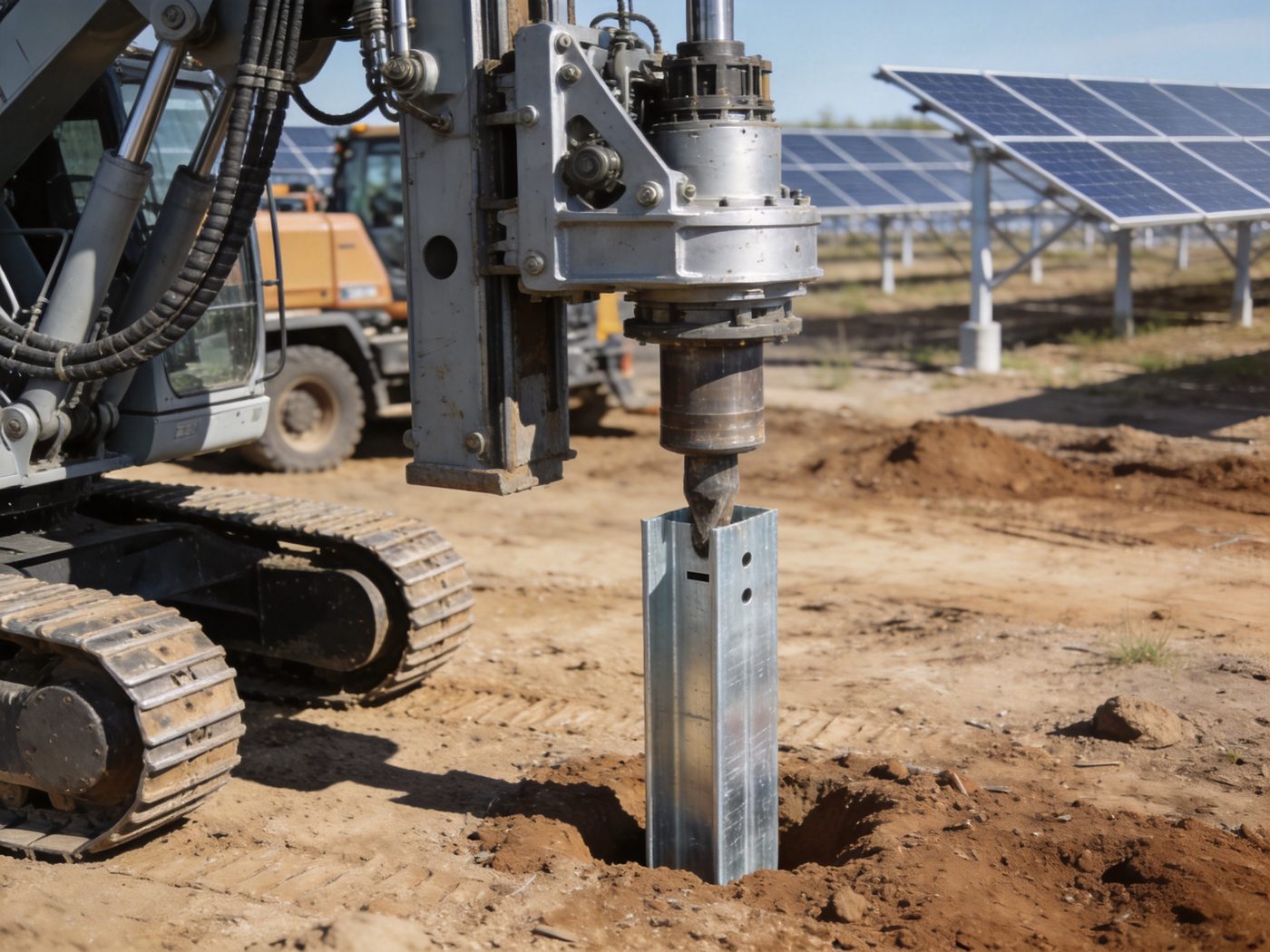
Best Application Scenarios
Utility-Scale Solar Farms with Schedule-Driven Development
Ground screw foundations are commercially optimized for utility-scale solar projects where foundation installation speed is a critical path item and the project development timeline cannot absorb the 10–21-day concrete cure delay or the geotechnical investigation lead time required for driven pile design verification. At ≥ 5 MWp on standard agricultural soil (N = 10–30), a ground screw program with two torque rigs producing 600 screws/day collectively completes the foundation installation for a 50 MWp project (approximately 10,000 screws) in approximately 17 working days — comparable to driven pile speed and 5–10× faster than concrete foundations at equivalent scale. For the complete engineering framework for utility-scale solar projects — including the foundation selection criteria that determine when ground screws, pile driving, or concrete are the optimal structural and commercial choice at large project scale — the utility-scale solar resource provides the decision framework across all terrain, soil, and climate conditions.
Agrivoltaic Systems: Minimal Soil Disturbance for Dual Land Use
Agrivoltaic systems — solar installations that maintain agricultural activity (cropping, grazing, bee keeping) beneath and between the solar panel arrays — require foundation installation methods that preserve soil structure and minimize compaction to maintain agricultural productivity. Ground screws are uniquely suited to agrivoltaic applications because: the small installation footprint of the torque rig minimizes soil compaction compared to pile driving rigs or concrete excavation equipment; the helical advancement mechanism compresses soil laterally without removing it, preserving soil stratification; the screw perimeter above and below grade is small enough that agricultural equipment operates within row spacing without obstruction; at end of project life, complete extraction with minimal residual soil disturbance returns the land to full agricultural use. In agrivoltaic projects where the agricultural lease requires demonstration of “no permanent land modification,” ground screw foundations with documented complete extraction at end of term are typically the only foundation type that satisfies this lease requirement.
Temporary and Relocatable Installations
Ground screws are the standard foundation choice for solar installations with defined project terms shorter than 25 years or with relocation requirements — including short-term land lease solar (5–15 year terms), construction site power, disaster response solar microgrids, and military deployable power systems. The extraction-and-reuse capability of ground screws makes them the most economically efficient foundation for repeated deployment: a ground screw extracted from Site A and re-installed at Site B is structurally viable if torque verification at Site B confirms capacity — the structural integrity of the extracted screw is verified by the achieved installation torque at the new site, not by visual inspection of the screw geometry. Extracted screws typically show some surface zinc wear at the helix-soil interface, but structural steel loss in standard service conditions over a 10–15-year project life is negligible, and the screw achieves full structural capacity at the new installation if design torque is reached.
Cost & ROI Considerations
Ground screw foundation cost comprises four components: screw hardware (shaft + helix assembly, HDG coated), torque rig operation (day rate × installation days), mobilization/demobilization, and pre-installation soil investigation. Unlike concrete foundations, ground screws require no concrete supply, no excavation equipment, no rebar, and no QA laboratory testing — reducing both direct cost and soft cost. Typical cost breakdown for a 50 MWp utility-scale project in standard US agricultural soil (N = 10–25, non-frost):
| Cost Component | Unit Cost | Total at 10,000 Screws | $/Wp |
|---|---|---|---|
| Ground screw hardware (89 mm OD × 1.8 m, single helix 250 mm, HDG 86 µm) | $42–$65/screw | $420,000–$650,000 | $0.0084–$0.0130 |
| Torque rig installation ($4,500–$6,500/day; 400 screws/day) | $11.25–$16.25/screw | $112,500–$162,500 | $0.0023–$0.0033 |
| Mobilization / demobilization (2 rigs) | $3,500/rig × 2 | $7,000 | $0.0001 |
| Soil investigation (20 borings at $3,500 each) | $7.00/screw | $70,000 | $0.0014 |
| Torque log QA review and documentation | $2.50/screw | $25,000 | $0.0005 |
| Total ground screw foundation cost | $66–$94/screw | $634,500–$914,500 | $0.013–$0.018/Wp |
At $0.013–$0.018/Wp, ground screw foundations are cost-competitive with driven pile foundations ($0.011–$0.019/Wp) and substantially lower than concrete foundations ($0.018–$0.035/Wp) at utility scale. Ground screws are commercially preferred over driven piles when: (a) noise or vibration restrictions prohibit impact hammer use; (b) schedule or logistics favor the lighter equipment (torque rig vs pile hammer rig); (c) reversibility has contractual value. Driven piles are preferred over ground screws when: (a) soil is dense gravel or cobble (N > 40) where ground screw installation is impractical; (b) lateral stiffness demand is very high (requiring H-pile sections not available in screw form); (c) project scale (> 50 MWp) justifies large pile hammer rig mobilization for maximum installation rate. For the complete cost analysis, see the foundation cost comparison resource; for the specific structural and commercial trade-off between ground screws and driven piles in standard utility-scale applications, see the pile vs ground screw comparison.
Comparative Engineering Matrix
| Criterion | Ground Screw | Pile Driven | Concrete | Ballasted |
|---|---|---|---|---|
| Installation Speed | ✅ Very Fast — 150–400/day/rig | ✅ Fast — 200–500/day/rig | ❌ Slow — 10–21 day cure | Fast — no curing needed |
| Real-Time Capacity Verification | ✅ Yes — torque log every screw | ⚠️ Partial — blow count only | ❌ No — cylinder test at 28 days | ✅ Yes — ballast count verification |
| Suitable for Rocky / Dense Soil (N > 40) | ❌ Pre-drill required | ⚠️ Pre-drill required at N > 50 | ✅ Yes — excavation bypasses rock | ✅ Yes — no penetration required |
| Lateral Stiffness (per unit mass) | Medium — tube section | ✅ High — wide flange or H-pile | ✅ Very High — mass + passive pressure | ❌ Low — no soil engagement |
| Frost Suitability | ✅ High — helix below frost | Medium — frost heave at thin sections | ✅ High — footing below frost | ⚠️ Moderate — ground-level systems only |
| Site Reversibility | ✅ High — reverse-torque extraction | Medium — crane extraction possible | ❌ Low — concrete demolition | ✅ Very High — no residual impact |
| Soil Disturbance During Installation | ✅ Minimal — lateral compression only | Moderate — vibration and displacement | ❌ High — excavation required | ✅ None — surface bearing only |
| CapEx ($/Wp at 50 MWp scale) | $0.013–$0.018 | $0.011–$0.019 | $0.018–$0.035 | $0.008–$0.018 (rooftop only) |
Ground screws lead on structural transparency (torque verification), site reversibility, and environmental impact — and are cost-competitive with driven piles across most standard utility-scale soil conditions. For a complete evaluation of all foundation types across the full range of soil, wind, frost, and project scale conditions, refer to our Solar Foundation Systems Guide.
Engineering Design Checklist
- Soil density verified by site investigation: SPT N-values or CPT qc by depth at representative locations; soil range confirmed within Kt torque correlation valid range (N = 5–40 standard); organic soil identified and corrosion specification upgraded accordingly
- Minimum installation torque Tmin calculated for each screw zone: design uplift and lateral forces per screw at interior, edge, and corner positions; Tmin = Qdesign/Kt per zone; Kt value from ICC-ES AC358 or manufacturer load test data for specified shaft size; Tmin confirmed achievable with proposed rig maximum torque output
- Frost depth confirmed and minimum embedment set accordingly: helix plate position confirmed below local frost depth + 200 mm; adfreeze force on shaft in frost zone calculated and confirmed < helix uplift capacity below frost
- Corrosion protection class specified for below-grade environment: soil ISO corrosion category determined from investigation data; HDG 86 µm for C2–C3 mineral soil; duplex (HDG + epoxy) for C4; stainless helix plates for organic soil; coating specification included in procurement documents
- Helix plate weld quality specified in procurement: weld procedure qualification per AWS D1.1 required from manufacturer; factory weld inspection records included in procurement deliverables; this cannot be field-verified after installation and coating — factory QC is the only control point
- Wind speed and exposure category confirmed for design load calculation: Vult per ASCE 7-22 Figure 26.5-1B; exposure category from upwind terrain fetch analysis; governing uplift and lateral force per screw position calculated for combined LRFD load combination
- Seismic zone reviewed for Ω0 applicability: SDC C–F sites require seismic force check at screw head connection; Ω0-amplified connection force at brace end screw positions in CBF systems; screw lateral capacity under seismic base shear verified
- Torque log QA protocol specified in construction documents: minimum torque record frequency (every 300 mm depth); acceptance criteria (final 300 mm average ≥ Tmin); disposition protocol for screws not meeting Tmin; delivery format for torque logs (electronic preferred for automated review)
Failure Risks & Common Engineering Mistakes
Insufficient Torque Verification: Accepting Screws Below Tmin Without Engineering Disposition
The most consequential ground screw installation error is accepting screws that fail to achieve the minimum installation torque Tmin without formal engineering review and disposition. This occurs when field supervisors — under schedule pressure — accept below-Tmin screws as “close enough” or attribute the shortfall to installation equipment variability rather than soil capacity deficiency. A screw installed at 80% of Tmin has approximately 80% of the design capacity — which may still satisfy the structural requirement with available safety factor margin, or may not, depending on how conservatively the design was specified. Every screw achieving less than Tmin must receive formal engineering disposition: accept with documented safety factor verification, deepen, add a sister screw at 600 mm offset, or replace with an alternative foundation element — not field-accepted without documentation.
Incorrect Embedment Depth: Stopping at Target Depth Without Torque Confirmation
A systematic field error in ground screw installation is stopping at the “design depth” specified on the drawings without recording whether Tmin was achieved at that depth. Design drawings specify a target embedment depth based on the design soil profile, but actual soil capacity at any individual screw location may be lower than the design profile (weaker soil zone), requiring additional depth to achieve Tmin. If the installation crew stops at target depth regardless of achieved torque, screws in weaker soil zones will be installed at below-design capacity without any field indication that a problem exists — the torque record will show the below-Tmin value, but if no one reviews it in real time, the structural deficiency passes undetected to the QA review phase, when remediation is more costly.
Corrosion Protection Failure: Standard HDG Specified in Organic or Coastal Soil
Specifying standard HDG 86 µm ground screws in organic soil (peat, muck, high-humus fill) or in C4–C5 coastal soil without supplementary protection is the most common long-term structural failure mechanism in ground screw solar foundations. Organic soil bacterial activity and acid chemistry depletes zinc coating at 15–30 µm/year — consuming standard HDG within 3–6 years and exposing bare steel that corrodes at 50–100 µm/year in the same environment. A 6 mm helix plate corroding at 75 µm/year (mid-range for coastal organic soil) loses 1.875 mm of wall thickness per 25 years — reducing the helix plate to 4.125 mm effective thickness, which reduces bearing area by (4.125/6.0) = 31% and reduces capacity by 31%. The failure is silent and progressive, detectable only by foundation extraction and physical measurement — typically after a wind event has displaced the compromised screws.
Installing in Rocky Layers: Forcing Advancement Past Resistance
Forcing a helical screw past a gravel or cobble layer by applying maximum rig torque to overcome the resistance — rather than stopping and pre-drilling — damages the helix plate at the point of contact with the rock fragment: the plate edge deforms, the weld between plate and shaft stress-concentrates, and in severe cases the helix plate partially separates from the shaft. The damaged helix plate has reduced bearing area and a compromised weld — reducing both capacity and ductility. The torque record for a damaged-plate screw may show a spike to high torque (during rock contact) followed by normal torque after the obstruction is passed — an anomalous torque signature that should be flagged for investigation. Field protocol: any screw showing a torque spike exceeding 150% of adjacent screws at equivalent depth must be extracted and inspected before re-installation.
Frequently Asked Questions
How does installation torque verify ground screw capacity?
Installation torque T (measured at the drive head during the final 300 mm of screw advancement) is directly proportional to the soil bearing stress on the helix plate at that depth: Qallowable = Kt × T, where Kt is the empirical torque factor (units: m⁻¹ or ft⁻¹) calibrated by load testing per ICC-ES AC358 or ASTM A1180 for the specific shaft diameter and soil type. At Kt = 33 m⁻¹ and measured torque T = 3,800 N·m: Qallowable = 33 × 3,800 = 125,400 N = 125 kN — both compression and uplift (with 10% reduction for uplift = 113 kN). The torque record therefore provides a complete structural capacity verification document for every installed screw, generated automatically during installation at no additional cost or schedule impact. This torque correlation method is accepted by major building codes (IBC 2024, ASCE 7-22), ICC-ES evaluation reports, and structural engineers as equivalent to static load testing for standard utility-scale solar foundation applications in soil with N = 5–40.
What is the difference between a ground screw and a helical pile?
“Ground screw” and “helical pile” refer to the same structural element — a steel shaft with welded helical bearing plates installed by rotary torque. The terminology difference is regional and commercial: “ground screw” is more common in European solar and construction markets (Erdschraube in German); “helical pile” or “helical anchor” is standard terminology in North American geotechnical engineering and ICC-ES evaluation reports; “screw pile” is common in Australian and UK markets. All three terms describe the same structural mechanism (helical plate bearing capacity correlated to installation torque) and are governed by the same design standards (ICC-ES AC358 in North America; EBGEO 2011 in Europe; AS 2159 in Australia). When reviewing product specifications, confirm the shaft diameter, helix plate diameter, steel grade, coating specification, and Kt value — these are the structurally significant parameters regardless of the terminology used.
Can ground screws be used in frozen or permafrost soil?
Ground screws can be installed in seasonally frozen soil using thermal pre-drilling (hot water or steam lance to soften the frozen surface layer before screw advancement) or mechanical pre-drilling with a rotary auger to break through the frozen crust. In permafrost — permanently frozen ground found in northern Canada, Alaska, Greenland, and Siberia — standard helical screws are not applicable; thermosyphon pile systems (passive heat exchange piles that maintain soil freezing around the pile by extracting heat) or cast-in-place concrete with insulation are the appropriate foundation types. For solar projects in seasonal frost zones (freeze and thaw annually), ground screws with helix plates below the frost depth are the standard engineering solution — the seasonal freeze-thaw cycle above the helix plate creates adfreeze tangential stress on the shaft (discussed above) but does not impair structural capacity if the helix remains in unfrozen soil below the frost line.
How are ground screws removed at end of project life?
Ground screw extraction at end of project life is performed by the same torque rig used for installation, applying reverse (counter-clockwise) rotation to unscrew the helix plates from the soil. Extraction rate is typically 2–4× faster than installation because the soil has been pre-disturbed by the installation process and the helical thread path is already formed in the soil. In cohesive soil, the extraction hole (typically 100–150 mm diameter for standard solar screws) closes naturally within one to two growing seasons as the surrounding soil consolidates back into the void. In cohesionless soil (sand, gravel), the hole may remain open for longer but is typically backfilled with native spoil immediately after extraction. Extracted screws are inspected for corrosion and structural damage; screws meeting minimum wall thickness and coating criteria may be reused at a new location, with capacity confirmed by torque log at the new installation — making ground screws the only solar foundation type with significant material reuse potential that directly reduces lifecycle cost.
What soil conditions are incompatible with ground screw foundations?
Five soil conditions present structural or installation challenges that may make ground screws incompatible or require design modifications: (1) Gravel or cobble-dominant soil (D50 > 60% of helix diameter): individual gravel fragments or cobbles exceeding approximately 150 mm in a 250 mm helix system prevent helical advancement or damage the helix plate — pre-drilling eliminates the installation speed advantage and may not fully resolve the problem if cobbles are continuous throughout the embedment zone; driven piles or concrete are structurally preferable at very rocky sites; (2) Very soft clay (SPT N < 5, su < 15 kPa): installation torque is too low to achieve a reliable correlation to capacity — Kt torque correlation has high variability at these strengths; supplementary static load testing is required, and embedment depths may exceed 3.5 m to achieve required uplift capacity, making larger-diameter helix plates and high-capacity rigs necessary; (3) Organic soil (peat, muck, high-humus fill): installation is typically possible but corrosion protection becomes the binding constraint — standard HDG coatings deplete within 3–8 years in organic soil, requiring stainless steel helix plates or full stainless screw sections for 25-year design life; organic soil sites require supplementary corrosion specification that increases cost by $20–$50/screw; (4) Expansive clay (montmorillonite, high plasticity index PI > 40): seasonal swelling and shrinkage of expansive clay creates cyclic heave and settlement forces on the screw shaft above the helix — alternating upward (swelling) and downward (shrinkage) forces fatigue the shaft-helix weld and can gradually displace the screw through accumulated cyclic heave; embedment must be designed to position the helix in the non-expansive layer below the active zone depth (typically 1.5–3.0 m for high-PI clays); (5) Liquefiable soil (loose saturated sand, SPT N < 15 in seismic zones): in SDC D–F seismic zones, loose saturated sand layers identified in the soil investigation as liquefaction-susceptible lose bearing capacity during seismic shaking — helix plates in the liquefiable zone lose their bearing resistance instantaneously at ground shaking onset; embedment must extend below the liquefiable layer to develop capacity in non-liquefiable soil, or ground improvement (densification, grouting) of the liquefiable layer must be performed before foundation installation. The detailed soil classification methodology that identifies these incompatible conditions during site investigation — and the alternative foundation type recommendations for each incompatible condition — is developed in the soil evaluation report resource.
How does ground screw performance compare to driven pile at equivalent project scale?
Ground screws and driven piles have overlapping structural capability in the N = 10–35 soil range that covers the majority of utility-scale solar sites — making the selection between them primarily a function of schedule, site constraints, and soil-specific performance. Ground screws outperform driven piles on: structural transparency (torque log vs blow count — torque directly correlates to capacity; blow count requires separate WEAP analysis or load testing for equivalent documentation); site reversibility (reverse-torque extraction vs crane pull-out); site disturbance (lateral compression vs displacement and vibration); and equipment mobilization weight (mini-excavator-mounted torque rig at 4–8 tonnes vs pile hammer rig at 15–35 tonnes for equivalent production rate). Driven piles outperform ground screws on: lateral stiffness per unit cost (wide-flange H-pile sections provide higher EI than equivalent-cost tube sections); performance in dense or rocky soil (driven piles with impact energy can advance through N = 40–50 soil where ground screws require pre-drilling); and unit installation rate at large scale (>100 MWp projects where large hammer rigs achieve 500+ installations/day).
Prepare for project-specific review
Use this guide to organize the site, load, system and compliance inputs that a product supplier, licensed engineer, installer or local authority will need. PVRack does not provide project-specific engineering approval or supplier quotations.