
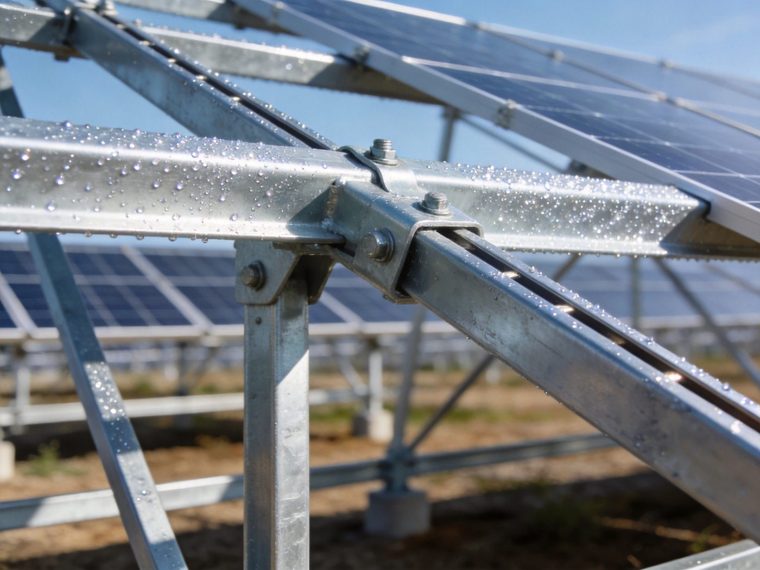
Hot-Dip Galvanized vs Pre-Galvanized: Direct Answer
| Decision factor | Hot-dip galvanized after fabrication | Pre-galvanized sheet or coil |
|---|---|---|
| When coating is applied | After cutting, punching and welding, so fabricated surfaces are immersed together | Before fabrication; later cuts, holes and welds require an explicit repair/protection strategy |
| Common specification route | ASTM A123/A123M or ISO 1461 for fabricated iron and steel articles | Coated-sheet specifications such as ASTM A653/A653M, with coating designation stated in the purchase order |
| Best starting point | Ground-mount, exposed foundations, coastal/industrial sites and long design lives | Controlled low-corrosion environments, protected rooftop members and roll-formed parts where cut-edge control is documented |
| Main procurement risk | Distortion, vent/drain detailing, coating fit at threads and repair of site damage | Unprotected cut edges, punched holes, weld zones and an RFQ that says only "galvanized" without a coating mass or thickness |
| What decides | Exposure category, required design life, steel thickness, fabrication sequence, drainage, inspection access and lifecycle maintenance—not appearance alone | |
Short answer: post-fabrication hot-dip galvanizing usually provides the more complete protection for exposed solar steel, while pre-galvanized steel can be appropriate when the environment and fabrication details are controlled. The project specification must state the governing standard, coating requirement, cut-edge/weld treatment and acceptance method.
Specification decoder: what the coating label must tell you
| RFQ field | What to state | Why it matters |
|---|---|---|
| Product route | Fabricated article galvanized after fabrication, or continuously coated sheet/coil formed later | Determines which surfaces exist when zinc is applied |
| Governing standard | For example ASTM A123/A123M or ISO 1461; for sheet, ASTM A653/A653M and the coating designation | “HDG” and “pre-galvanized” alone are not acceptance criteria |
| Coating requirement | Applicable material category and thickness, or sheet coating mass/designation | G90 is total coating mass on both sides, not a 90 μm thickness |
| Fabrication after coating | Cut, punch, bend and weld schedule; maximum exposed area; approved edge/weld treatment | Later fabrication changes the protection at local areas |
| Inspection and repair | Sampling, calibrated thickness measurement, visual acceptance, handling-damage limits and repair standard such as ASTM A780 where applicable | Turns a coating promise into an auditable deliverable |
| Exposure basis | Atmospheric/soil data, drainage, salts or pollutants, wetness, design life and maintenance access | Allows a project-specific time-to-maintenance estimate |
Procurement stop: do not approve an RFQ that says only “galvanized,” converts a G designation directly to micrometres, promises a universal lifespan without an exposure basis, or omits post-fabrication and repair rules.
Engineering Overview
In multi-megawatt solar portfolios, coating selection is a lifecycle-risk decision. Post-fabrication hot-dip galvanizing commonly provides thicker, more complete coverage of fabricated steel, while pre-galvanized material can reduce cost and provide a controlled finish for suitable roll-formed components. Neither label is a complete specification: coating designation, steel thickness, fabrication sequence, cut-edge treatment and exposure all affect durability.
Using pre-galvanized steel in a severe coastal or industrial environment without a project-specific corrosion assessment increases maintenance and section-loss risk. To select the coating systematically, review the galvanization methods for solar mounting, the broader corrosion protection system and the applicable contract standards. This solar mounting comparison hub helps connect metallurgical durability with procurement and lifecycle cost.
Quick Engineering Recommendation
| If You Need | Recommended Option |
|---|---|
| 25+ year outdoor durability (Utility-scale) | Hot-Dip Galvanized |
| Lower upfront material cost (Budget constrained) | Pre-Galvanized |
| Coastal / high corrosion zone (C4/C5 environments) | Hot-Dip Galvanized |
| Indoor, protected, or light exposure (Rooftops) | Pre-Galvanized |
Technical comparison
| Factor | Batch HDG after fabrication | Continuously galvanized sheet |
|---|---|---|
| Coating point | Fabricated article is immersed after most cutting, punching and welding | Sheet/coil is coated before later forming and fabrication |
| Typical specification | ASTM A123/A123M or ISO 1461, as applicable | ASTM A653/A653M plus coating designation, as applicable |
| Coating requirement | Varies by product category and steel thickness under the selected standard | Specified by coating mass/designation; G90 is 0.90 oz/ft² total both sides |
| Edges after fabrication | Pre-dip fabricated surfaces reached in immersion receive coating; later field cuts do not | Later cuts and punches expose local steel; nearby zinc may protect small areas cathodically |
| Design constraints | Venting, drainage, distortion, threads, fit and handling damage | Formability, edge/weld protection and often lower zinc mass |
| Life prediction | Use measured/required zinc thickness, environment, local details and maintenance plan; do not assign universal years | |
What is batch hot-dip galvanizing?
Prepared fabricated steel is immersed in molten zinc, producing metallurgically bonded zinc-iron layers and an outer zinc layer on surfaces reached during the process. The applicable standard sets minimum requirements by material category and thickness. The designer must coordinate venting, drainage, distortion, threads and inspection with the fabricator and galvanizer.
What is pre-galvanized or continuously galvanized sheet?
Steel sheet is coated in a continuous line and later formed, cut or punched into components. Air knives control a consistent coating mass. A common G90 designation means 0.90 oz/ft² total across both sides—approximately 20 μm per side if evenly distributed—not a 90 μm coating.
Later fabrication can expose local steel. Surrounding zinc may provide limited cathodic protection to small exposed areas, but the specification still needs an edge, weld and damage rule based on geometry and exposure.
Cost engineering
Compare complete compliant alternatives: steel and fabrication, galvanizing route, transport between facilities, packing, coating inspection, edge or damage repair, installation and expected maintenance. Continuous processing can be efficient, while batch galvanizing can provide a thicker coating and post-fabrication coverage; neither creates one universal percentage premium.
RFQ comparison
Ask each supplier to complete the same coating schedule for every component. Keep foundation and above-ground members separate when their exposure differs.
| Required field | Supplier response |
|---|---|
| Component and steel product form | Grade, thickness and fabrication drawing reference |
| Process and standard | Named galvanizing route, governing standard and edition |
| Coating acceptance | Required thickness/category or mass designation, sampling and test records |
| Post-coating fabrication | Every cut, punch and weld plus approved protection method |
| Handling and field repair | Damage limits, inspection and repair standard |
| Exposure/design-life basis | Environment, maintenance assumptions and time-to-maintenance calculation |
Structural performance and durability
Galvanizing does not make two different members structurally identical. Steel grade, thickness, section geometry, cold forming, holes, welds and connections still govern strength and stiffness. Coating loss matters when it eventually allows base-steel section loss, but that progression must be assessed from the actual detail and exposure.
For atmospheric zinc coatings, thickness and environment are key life inputs. “Time to first maintenance” is a maintenance threshold, not total structural service life. Soil-contact components require site-specific soil and drainage data; do not approve them from an atmospheric category alone.
Installation and repair controls
- Inspect coating condition after transport, driving, cutting or field fit-up.
- Use the project’s approved repair method; ASTM A780/A780M is a common reference for batch-HDG repair.
- Control welding fume hazards and restore coating where welding removes protection.
- Keep drains and crevices clear, and record repaired areas for follow-up inspection.
Long-term verification
Set inspection intervals from exposure, component criticality, measured condition and warranty requirements. Track cut edges, welds, fasteners, ground-line transition zones, water traps and repaired damage. Escalate unexpected red rust or coating loss rather than assigning a failure year from the coating label.
Conditional decision matrix
| Condition | Selection response |
|---|---|
| Marine, industrial or persistent wetness | Use a corrosion assessment; compare heavier zinc, batch HDG, duplex systems, suitable Zn-Al-Mg products or other materials |
| Soil contact | Use soil chemistry/resistivity, moisture and abrasion/installation data; specify the transition zone separately |
| Mild, drained atmospheric exposure | Continuous-sheet products may be viable when coating designation and edge treatment support the design life |
| Field cutting or welding expected | Choose only with a documented repair, inspection and acceptance plan |
| Unknown exposure or coating designation | Stop procurement and obtain the missing data |
Engineering decision sequence
- Classify the actual exposure. Record atmospheric and, where relevant, soil chemistry, salts/pollutants, wetness, drainage and inspection access.
- Set design life and maintenance strategy. Distinguish time to first maintenance from total structural service life.
- Map the fabrication route. Identify every cut, punch, bend and weld before and after coating, including field modifications.
- Compare compliant specifications. State the governing standard, coating requirement, repair method and inspection sampling for each alternative.
- Estimate lifecycle cost. Include fabrication constraints, coating inspection, field repair, expected maintenance and replacement access.
Escalate to a corrosion-qualified engineer when the site is marine, industrial, persistently wet, in aggressive soil, or when a 25–30 year claim cannot be supported by measured coating and exposure data.
Frequently Asked Engineering Questions
What does G90 mean?
For continuously galvanized sheet, G90 denotes 0.90 oz/ft² total zinc coating mass across both sides. It is not 90 micrometres; the American Galvanizers Association gives roughly 20 micrometres per side when evenly distributed.
Are cut edges on pre-galvanized sheet completely unprotected?
No. Cutting exposes steel, but nearby zinc can provide limited cathodic protection to small exposed areas. Edge size, sheet thickness, coating mass and environment determine whether added treatment is needed.
Does hot-dip galvanizing guarantee a fixed number of years?
No. The standard defines coating requirements and acceptance, while time to first maintenance depends on measured coating thickness and environment. Time to first maintenance is also not the same as total service life.
What must an RFQ say beyond galvanized?
State the product route, governing standard, coating requirement or designation, fabrication sequence, cut-edge and weld treatment, inspection sampling, repair method and exposure/design-life basis.
How should installation damage be handled?
Inspect the size and location against the project specification. Where repair is required for batch HDG, ASTM A780/A780M is a common reference for acceptable repair methods.
Prepare for project-specific review
Use this guide to organize the site, load, system and compliance inputs that a product supplier, licensed engineer, installer or local authority will need. PVRack does not provide project-specific engineering approval or supplier quotations.
Evidence and Related Solar Mounting Resources
Research evidence used for this revision
- ISO 1461:2022 official scope: batch hot-dip coatings on fabricated iron and steel articles; continuously galvanized sheet is outside this standard's scope.
- ASTM steel standards catalog: current listings for A123/A123M and A780/A780M.
- American Galvanizers Association — Continuous Sheet Galvanizing: process, G90 interpretation, cut edges and coating-life context.
- American Galvanizers Association — ASTM Specifications: A123 coating and A780 repair scope.
- American Galvanizers Association — Estimating Coating Life: thickness/environment inputs and the distinction between maintenance timing and service life.
- U.S. Department of Energy — PV Corrosion Guidance: solar-specific exposure assessment, dissimilar metals and maintenance controls.
Use these sources to define the process and evidence request, then verify the exact standard edition and project requirements in the contract documents:
Related Mounting Types
Related Material Guides
Related Cost Analysis
Return to Comparison Hub