
Engineering Overview
In commercial and industrial (C&I) solar deployment, the roof is not just a mounting surface; it is a critical building asset protecting multimillion-dollar interior operations. The engineering decision between utilizing ballasted solar mounting systems and penetrating anchored architectures represents a strict balance between structural load capacity and waterproofing risk. The engineering consensus dictates that ballasted systems are the preferred solution for flat commercial roofs with high dead-load capacities, as they completely eliminate roof membrane penetrations, thereby neutralizing immediate waterproofing risks. However, they introduce significant supplemental weight to the building’s structural trusses.
Conversely, penetrating systems establish a direct, mechanical connection with the building’s underlying framework. While this necessitates highly specialized waterproofing and flashing procedures to prevent future leaks, it provides absolute, uncompromising wind uplift resistance and drastically reduces the dead-load imposed on aging or lightweight structures. For EPCs navigating this complex architectural crossroad, this solar mounting comparison hub serves as the definitive baseline for evaluating which roof mounted solar systems will guarantee 25-year structural survival while preserving the host building’s integrity.
Quick Engineering Recommendation
| If You Need | Recommended System |
|---|---|
| No roof penetration / zero waterproofing risk | Ballasted |
| High wind resistance (Hurricane zones) | Penetrating |
| Lightweight roof structure (low dead-load capacity) | Penetrating |
| Flat commercial roof with standard EPDM/TPO | Ballasted |
Ballasted vs Penetrating – Technical Comparison
| Evaluation Factor | Ballasted | Penetrating |
|---|---|---|
| Installation Cost | Moderate | Moderate |
| Structural Strength | Good | Excellent |
| Wind Resistance | Depends on ballast weight | Very High |
| Maintenance Needs | Low | Moderate |
| Lifespan | 20–25 yrs | 25+ yrs |
| Energy Yield Impact | Neutral | Neutral |
| Installation Speed | Fast | Slower |
| Best Application | Flat roofs | High wind zones |
This technical matrix underscores the inverse relationship between roof weight and wind resistance. Ballasted systems utilize gravity, requiring heavy concrete blocks to counteract aerodynamic lift, ensuring a rapid installation devoid of drilling. Penetrating mounts transfer the aerodynamic lift directly into the building’s steel or timber purlins, enabling extreme wind ratings with minimal added weight, but slowing construction velocity due to the meticulous sealing required at every drill point.
What Is a Ballasted Solar Mounting System?
Technical Definition
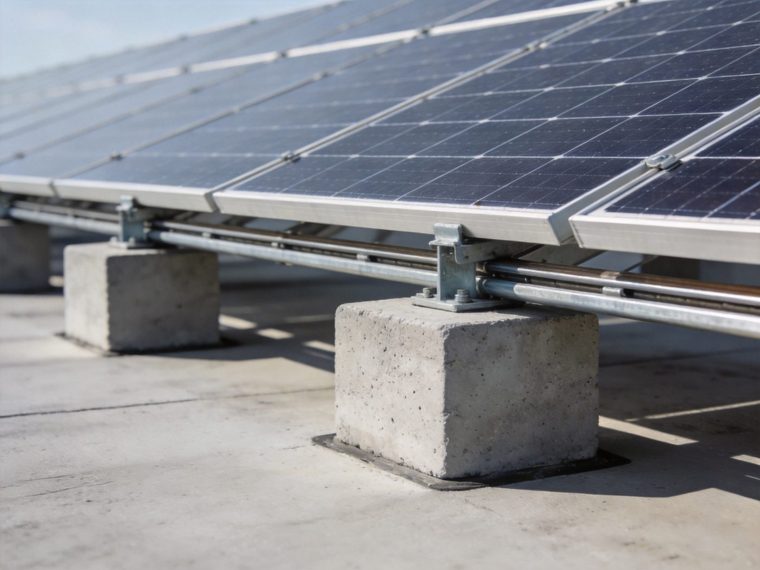
A ballasted solar mounting system is an aerodynamically optimized, non-penetrating structural framework that relies entirely on gravitational dead-weight and wind deflection to secure photovoltaic modules to a flat roof. Instead of utilizing mechanical anchors that pierce the roofing membrane, the aluminum racking framework features specialized trays or “pans” designed to hold heavy concrete masonry units (CMUs). The cumulative weight of these blocks, combined with the weight of the modules and racking, anchors the array to the building.
Structural Characteristics
The core structural characteristic of a ballasted system is its heavy reliance on computational fluid dynamics. Because the system is merely “resting” on the roof, developers must execute a highly rigorous wind load calculation to determine the exact number of concrete blocks required in specific roof zones (e.g., roof corners and perimeters require significantly more ballast due to vortex shedding). To minimize this ballast requirement, engineers utilize tilt angle optimization, frequently selecting a low 5-to-10-degree tilt and integrating rear wind deflectors to encourage wind to pass smoothly over the array rather than lifting it. Rubber slip-sheets are placed beneath all racking components to prevent the metal from grinding against the delicate TPO, PVC, or EPDM roof membranes.
Typical Applications
Ballasted architectures are the undisputed standard for large-scale commercial solar mounting projects. They are almost exclusively deployed on vast, low-slope warehouses, distribution centers, and big-box retail stores, representing the vast majority of modern flat roof solar mounting volume.
Advantages
The paramount advantage is the absolute preservation of the host building’s waterproofing envelope. By eliminating drilled holes, EPCs completely bypass the risk of inducing interior water leaks, preserving the building owner’s expensive commercial roof warranty. Furthermore, because components do not require exact alignment with subterranean roof trusses, installation velocity is exceptionally fast, allowing crews to lay out megawatts of capacity in highly flexible configurations.
Limitations
The fundamental limitation is structural dead-load. A fully ballasted array can add 4 to 7 pounds per square foot (PSF) of continuous weight to the roof. Many older commercial buildings simply lack the structural truss capacity to safely bear this massive gravitational addition, particularly in northern climates where seasonal snow loads must also be factored into the engineering equation.
[image:4]
What Is a Penetrating Solar Mounting System?
Technical Definition
A penetrating solar mounting system is a highly rigid structural attachment that mechanically anchors the solar racking directly into the host building’s primary load-bearing infrastructure (rafters, purlins, or steel decking). This involves drilling completely through the exterior waterproofing membrane and utilizing specialized fasteners—such as heavy-duty lag bolts, self-tapping steel screws, or chemical anchors—to establish a permanent structural lock.
Structural Characteristics
The defining feature of a penetrating system is its direct load transfer pathway. By bypassing the roof membrane and attaching straight to the structural steel or timber, the system leverages the massive tensile strength of the building itself to resist extreme aerodynamic uplift. To prevent water ingress at the penetration point, engineers rely on sophisticated structural connection design, utilizing integrated aluminum flashings, EPDM rubber gaskets, and industrial-grade butyl or polyurethane sealants. Because these mounts can withstand immense pull-out forces, they easily comply with the most stringent hurricane-zone wind load standards without requiring any concrete ballast blocks.
Typical Applications
Penetrating mounts are mandatory on steep-sloped roofs where gravity-based ballasts would simply slide off. They are also extensively utilized in metal roof solar mounting (where specialized clamps grip the seams, or screws penetrate the corrugated valleys), and on lightweight flat roofs that have failed the structural dead-load audit required for ballasted systems.
Advantages
The primary engineering advantage is a massively reduced roof weight footprint (often less than 3 PSF), allowing older, fragile buildings to host solar arrays safely. They also provide absolute structural certainty in extreme weather; a properly anchored penetrating system will hold the array fast against Category 5 hurricane winds and high-magnitude seismic shear forces that would otherwise displace a ballasted array.
Limitations
The critical limitation is waterproofing risk and installation complexity. Every single drill hole represents a latent liability. If a single EPDM washer fails or a contractor misses the structural rafter and drills only into the thin roof decking, water will eventually infiltrate the building, causing devastating interior damage. Consequently, installation is slow, requires highly skilled roofing labor, and often necessitates a complex warranty negotiation with the existing roof manufacturer.
[image:4]
Cost Engineering Analysis
Evaluating the true cost of a roof-mounted system requires looking beyond the racking invoice. The financial model must encompass structural engineering audits, specialized roofing labor, and the severe long-term liabilities associated with membrane degradation.
Initial Material Cost
The base aluminum hardware cost for both systems is relatively similar. However, ballasted systems require the localized procurement and crane-lifting of thousands of concrete blocks, driving up the gross material volume. Penetrating systems substitute concrete with highly engineered, expensive flashing kits, chemically treated lag bolts, and specialized stanchions. A rigorous solar mounting material cost breakdown reveals that while the components differ wildly, the absolute per-watt hardware cost is closely competitive.
Roof Structural Reinforcement Cost
This is the ultimate hidden cost of ballasted systems. If a Licensed Structural Engineer determines the building cannot support the 6 PSF dead-load of a ballasted array, the EPC must physically reinforce the building’s interior steel joists. This structural reinforcement is catastrophically expensive, frequently rendering the solar project economically unviable and forcing a pivot to a penetrating design.
Waterproofing & Sealing Cost
Penetrating systems carry a heavy premium in waterproofing materials and labor. Utilizing third-party roofing contractors (to maintain the building’s roof warranty) to properly install “pitch pockets” or heat-weld TPO patches around hundreds of metal stanchions introduces a massive, highly specialized labor cost that ballasted systems entirely avoid.
Installation Labor & Equipment
Ballasted installation is a rapid mechanical assembly process, executed swiftly by standard solar labor. However, it requires expensive crane rentals to hoist pallets of heavy concrete to the roof. Penetrating installations require slower, more meticulous labor to locate hidden subterranean rafters, drill accurately, and seal the flashings properly, pushing the hourly labor burn rate significantly higher.
25-Year Lifecycle Cost
When executing a complete 25-year lifecycle cost analysis, penetrating systems frequently carry a higher latent financial risk due to potential water leaks and the extreme cost of unbolting the system during an inevitable commercial roof-replacement cycle. Ballasted systems, while heavier, can be easily disassembled and moved aside during roof maintenance, protecting long-term ROI.
Structural Performance Comparison
A rooftop array operates in a highly dynamic, hostile aerodynamic zone. The structural mounting method must seamlessly manage extreme localized forces without compromising the host building’s primary safety factors.
Wind Uplift Resistance
Rooftops generate severe aerodynamic lift, particularly at the corners and parapet edges where vortex shedding occurs. To comply with rigorous wind load standards, a penetrating system acts as a mechanical restraint, using the building’s mass to hold the array down. A ballasted system must rely entirely on gravity; in extreme hurricane zones, the required weight of concrete blocks becomes so massive that the roof cannot safely support it, legally forcing the use of penetrating or “hybrid” anchored solutions.
Roof Load Distribution
Ballasted systems distribute weight widely across the roof membrane using specialized spreader pans. While the total aggregate weight is high, the point-load (PSI) on the insulation is kept low. Penetrating systems concentrate the entire weight of the array, plus heavy downforce wind loads, onto the small footprint of the stanchions attached to the rafters.
Waterproof Integrity Risk
This is the defining divergence. Ballasted systems present virtually zero risk to waterproof integrity, provided thick rubber slip-sheets are used to prevent the aluminum from slowly sawing through the membrane via thermal expansion and contraction. Penetrating systems present a permanent, high-risk liability. Every hole is a potential leak path that will be relentlessly tested by decades of standing water, freeze-thaw cycles, and UV-degraded sealants.
Seismic Stability
In high-magnitude earthquake zones, ballasted arrays are designed to slide slightly to absorb lateral shear forces. However, if they slide too far, they can crash into parapet walls or sheer electrical conduits. To meet modern seismic standards, ballasted systems often require selective mechanical tethering. Penetrating systems are rigidly bolted to the structure, meaning they absorb the full violence of the building’s seismic sway without sliding.
Corrosion Durability
Both systems utilize high-grade aluminum and stainless steel components to resist atmospheric corrosion. However, penetrating systems must also protect the exposed carbon steel of the host building’s rafters from rusting where the drill bit breached the wood or metal, necessitating heavy zinc-rich sealants at the connection point.
Installation & Construction Complexity
Site Preparation Requirements
Ballasted system preparation involves sweeping the roof and staging rubberprotective mats. Penetrating site prep requires intense structural mapping. Contractors must review architectural as-built blueprints and physically measure the roof deck to map the exact location of the underlying load-bearing trusses to ensure the lag bolts hit solid structure rather than empty airspace.
Roof Inspection Requirements
Before a ballasted system is approved, a Licensed Structural Engineer must core-sample the roof to determine the compressive strength of the underlying polyiso insulation, ensuring the concrete ballasts will not crush the insulation and create pooling water depressions. Penetrating systems require a rigorous audit of the existing membrane warranty to ensure drilling will not void the building owner’s coverage.
Installation Timeline
Ballasted timelines are highly predictable and extremely fast, functioning almost like a giant erector set. Penetrating timelines are notoriously slow and susceptible to weather delays; contractors cannot expose open drill holes during rainstorms, frequently pausing construction to ensure the building envelope remains watertight.
Safety Considerations
Both installations require strict adherence to OSHA fall-protection standards. However, ballasted systems require the heavy manual lifting and distribution of thousands of 30-pound concrete blocks across an active roof deck, introducing severe ergonomic and musculoskeletal injury risks for the installation crew.
Long-Term Operational Impact
Maintenance Frequency
A rooftop solar array operates out of sight, meaning neglected maintenance can lead to catastrophic building damage. Asset managers utilizing penetrating systems must execute a strict, annual routine inspection checklist focused heavily on the degradation of roof flashings, caulking, and butyl sealants. Ballasted systems require periodic checks to ensure high winds have not shifted the array from its original footprint.
Waterproof Monitoring Risk
Penetrating systems require active leak detection protocols. When commercial roof sealants age and crack under intense UV exposure (typically around Year 10), slow leaks can develop that saturate the roof insulation long before water drips onto the interior floor, rotting the building from the inside out.
Structural Settlement
Over a 25-year lifespan, the heavy, constant dead-load of a ballasted array can cause the commercial roof insulation beneath the blocks to slowly compress and settle. This creates slight depressions in the roof membrane that trap rainwater, accelerating roof decay and feeding potential algae growth around the solar array.
25-Year Reliability Projection
Both architectures will reliably hold the photovoltaic modules securely for 25 years. The reliability question lies entirely with the roof. If the commercial roof must be replaced at Year 15, unbolting and resealing a penetrating system is vastly more complex, expensive, and damaging than simply lifting and shifting a modular ballasted system.
Decision Matrix by Roof Condition
Architectural reality dictates the engineering specification. Apply the following matrix to eliminate catastrophic procurement failures.
| Roof Condition | Recommended Option | Engineering Reason |
|---|---|---|
| Flat concrete roof (High capacity) | Ballasted | Zero penetration risk; structure easily handles the heavy dead-load. |
| Lightweight steel truss roof | Penetrating | Requires lower dead load; steel trusses cannot safely support heavy concrete ballasts. |
| High wind coastal / Hurricane zone | Penetrating | Provides extreme mechanical anchoring where ballasts would become too heavy to use. |
| Old membrane roof (near replacement) | Ballasted | Avoids drilling into degraded material; easily shifted during future reroofing. |
| Heavy snow region | Penetrating | Combined weight of ballasts + deep snow will violently exceed roof structural limits. |
Engineering Decision Flowchart
Execute this rapid roof-triage logic to determine the correct structural architecture:
Step 1: Structural Load Capacity. Has a PE-stamped structural audit confirmed the roof can safely support an additional 6 lbs/sq ft of dead-load (including localized ballast concentrations)?
→ Yes → Evaluate Ballasted System.
→ No → Penetrating System is mandatory.
Step 2: Wind & Seismic Zone. Is the building located in an extreme hurricane corridor (Category 4+) or a high-shear seismic zone requiring fixed mechanical tethering?
→ Yes → Penetrating System (or a hybrid anchored system) is required for absolute kinetic resistance.
→ No → Proceed to Step 3.
Step 3: Waterproofing & Warranty. Is the building owner highly concerned about roof leaks or voiding a strict manufacturer’s membrane warranty?
→ Yes → Ballasted System is the optimal non-invasive solution.
Frequently Asked Engineering Questions
What is a “hybrid” roof mounting system?
A hybrid system utilizes the aerodynamic design and minimal hardware of a ballasted array, but strategically replaces some of the heavy concrete blocks with mechanical penetrating anchors. This is commonly deployed in high-wind zones where a purely ballasted system would be too heavy for the roof to support, offering a compromise between reduced roof weight and minimized roof penetrations.
Will a penetrating system automatically void my commercial roof warranty?
Not automatically, but it requires extreme coordination. To preserve a commercial roof warranty (e.g., Carlisle, Firestone), the EPC must utilize a roofing contractor certified by that specific membrane manufacturer to perform the flashings and seal the penetrations. If an uncertified solar laborer drills and seals the hole, the warranty is instantly voided.
How do you calculate the required ballast weight?
Ballast requirements are never guessed; they are derived from complex computational fluid dynamics (CFD) and wind-tunnel testing. Engineers input the building’s height, parapet wall height, local wind speed, roof zone (corners experience vastly more uplift than the center), and the array’s tilt angle into specialized software. The output dictates the exact number of concrete blocks required for each specific module tray.
What happens to a ballasted system during a seismic event?
Because ballasted systems are not bolted down, they will slide across the roof membrane during a severe earthquake. Engineers calculate this “seismic displacement.” If the calculations show the array might slide into a parapet wall, fall off the edge, or rip electrical conduits, the system must be mechanically tethered to the roof deck to restrict its range of motion.
Can a ballasted system damage the roof insulation underneath the membrane?
Yes. If the commercial roof utilizes soft Polyisocyanurate (Polyiso) insulation, the concentrated weight of the concrete blocks can compress the foam over time. This creates localized depressions in the roof that trap water (ponding). To prevent this, structural engineers must verify the compressive strength of the insulation prior to specifying a ballasted system.
What happens to a penetrating system during a reroofing project?
It is a highly expensive logistical challenge. The entire solar array must be electrically disconnected, the modules removed, and the racking unbolted from the stanchions. After the new roof is laid, new flashings must be installed around the existing stanchions, and the array must be completely rebuilt and re-commissioned, severely impacting the project’s long-term ROI.
Related Solar Mounting Resources
Secure your rooftop architectural strategy by cross-referencing your load parameters with our comprehensive engineering databases:
Related Mounting Types
Related Foundation Guides
Related Cost Analysis
Return to Comparison Hub